


The previous earlier article in this series described an inverted didactic model: the method. This article describes the person for whom that method was built. At the centre is the brake — the habit of deeply perceptive people to reason away a direct apprehension, a knowing that is present before the reasoning that could support it, until it has been made defensible. That habit is typically read as a deficit: uncertainty, overthinking, lack of self-confidence. This article argues the opposite. The brake is not a fault that persisted. It is a highly developed skill — a developmental product of decades of calibration, reinforced by giftedness itself.
I first describe what the brake is precisely and where it comes from, connecting it to three traditions: dual-process psychology, the work on tacit knowing, and the psychology of giftedness. Three developmental forces — intellectual overexcitability, the impostor phenomenon, and lifelong calibration — each contribute a component to one practised reflex. A separate section explains why that reflex remains invisible: it wears the mask of a virtue. The mechanism extends beyond giftedness; that is its most visible form, not its only one. The article closes with the bridge back to the method: this is precisely why only a subtractive pedagogy can, for a moment, lift this brake.

Inversion
The Brake as Achievement
Almost every description of deeply perceptive, gifted adults begins from a deficit. The terms in circulation — uncertainty, overthinking, fear of failure, perfectionism, analysis paralysis — all point to something going wrong, something too much or too little. Both the clinical and the self-help register read hesitation as a defect to be repaired or overcome. The message is invariably: trust yourself more, think less, dare to leap.
This article begins from the opposite premise. The habit of reasoning away a direct perception — hereafter the brake — is not a fault that was left behind. It is a skill that was built: practised over years, repeatedly rewarded, and refined to considerable precision. To call it a deficit is to confuse an achievement with a symptom. And that confusion is not an innocent terminological error; as “Invisibility” shows, it is itself part of the reason the brake persists so stubbornly.
The brake is not a fault that persisted. It is a skill that was built.
The stakes of the inversion are practical, not rhetorical. A deficit calls for addition: learn something new, practise trust, supply the missing courage. A skill calls for something entirely different. A highly practised reflex cannot be removed by talking over it; at most it can, under very specific conditions, be allowed to rest for a moment. Whoever treats the brake as a deficit will inevitably choose addition — and in doing so feeds exactly what they intended to relieve. Only someone who recognises it as a skill sees why only a subtractive pedagogy has any chance.
Phenomenology
What the Brake Actually Is
The brake is not doubt in general, and it is not a character trait. It is a specific action, and it takes place in an instant. Someone who sees sharply sees directly first — a direction, a judgement, an it is here that exists before the reasoning that could carry it. Then, almost immediately, comes a second movement: not the question is this right?, but the question can I defend this? And the answer is constructed — after the fact, retroactively — until the perception has been replaced by its defensible version. What remains is the reasoning. The perception itself is no longer accessible.
The crucial word is replaced. The brake does not defer the direct apprehension, and it does not test it; it overwrites it. Between seeing and accounting lies at most half a second, and in that half second the original disappears beneath the reconstruction. That is what distinguishes the brake from healthy reflection. Reflection returns to a perception and weighs it; the brake causes the perception to vanish before it can be weighed.
In the terms of dual-process psychology this is precisely locatable.1 There is a fast, intuitive system that delivers the direct reading, and a slow, deliberative system that processes it. For most people the second system is a scarce resource that occasionally corrects the first — often rightly, because an unreliable impression should be corrected. The brake is the case in which the deliberative system does not correct incidentally but overwrites habitually, including — and especially — when the reading rests on years of trained pattern recognition. Then the overwriting is not the solution but the problem.
Why does that direct apprehension not immediately lend itself to justification? Because it is of a kind that resists immediate articulation. Polanyi summed this up in the observation that we know more than we can tell2: an essential part of competence is implicit. Dreyfus and Dreyfus showed that the expert does not act from explicit rules but from fluid, holistic pattern recognition, and that forcing back to rules can degrade performance.3 The direct apprehension is that expert reading. The demand that it immediately account for itself is therefore not a neutral question — it forces a tacit knowing into a form it does not have, and in that forcing it is lost.
Origin
Where the Brake Comes From
A skill has a learning history, and the one belonging to the brake can be told. A child who sees too fast discovers early that the direct version does not land. It is too fast, too much, too far ahead of the room; it is not understood, or not believed, or read as showing off. What does land is the translated version: slower, supported, furnished with the steps the other can follow. So the child learns to translate. It learns to soften, to calibrate, to provide grounds — and is rewarded for it, repeatedly, because the processed version reaches where the raw one was deflected.
This is what practice calls calibration: the permanent assessment of what the other can receive, and the consequent adjustment of one’s own pace, one’s own perception, one’s own mode of expression. Over years, this adjustment becomes automatic. And then the decisive shift occurs: the calibration, once directed outward, turns inward. Where you first calibrated what you showed others, you eventually calibrate what you show yourself. The justification is then no longer a bridge to the other; it has become a precondition for the perception to be permitted to exist at all.
First you calibrate what you show others. Eventually you calibrate what you show yourself.
This explains why the brake feels like the person themselves, and not like something they do. A habit practised every day for thirty years and rewarded every day does not present itself as a habit but as a nature. But the learning history shows that it is indeed something acquired — adaptively earned, under real social pressure, with traceable reward. That is precisely the definition of a skill, and it is also the only opening: what has been learned can — under the right conditions — be momentarily set aside. Not unlearned; it sits too deep and has been too useful for that. But not performed, for the duration of a moment.
Amplification
Why the Brake Grows Alongside Giftedness
If the brake were only a product of calibration, it would be equally strong in everyone who has had to translate for a long time. But there is a second factor that amplifies it disproportionately in gifted people: giftedness itself. The deliberative apparatus that overwrites the direct reading is, in this population, more powerful, faster, and more inventive. That means the overwriting is more convincing, more complete, and harder to catch in the moment it happens.
The logic is bitter. The greater someone’s cognitive power, the more watertight the counter-argument they can construct against their own simplicity. A less agile thinker who sees something directly does not immediately have a conclusive case ready to invalidate it; the gifted person does. The mind argues against simplicity, with greater force the more gifted the person is. The instrument that sees fastest also delivers the sharpest material with which to overwrite that seeing.
What should serve the perception overwrites it instead — and the sharper the gift, the more complete the overwriting.
It is important to read this amplification as a developmental fact, not a didactic point. In the earlier article the same observation served to justify an intervention rule — no move may feed the back-reasoning. Here it concerns something prior: how the brake became so large in the first place. Giftedness did not only make it possible; it fed it. Every time the deliberative capacity successfully invalidated a direct apprehension, the habit was confirmed and the reading distrusted one degree further. The gift and the brake grew together; they cannot be thought separately.
The Three Amplifiers
Energy, Motive, and Habit
The brake is not a single phenomenon but a composite. Three developmental forces each contribute a separate component, and only together do they form the highly practised reflex.
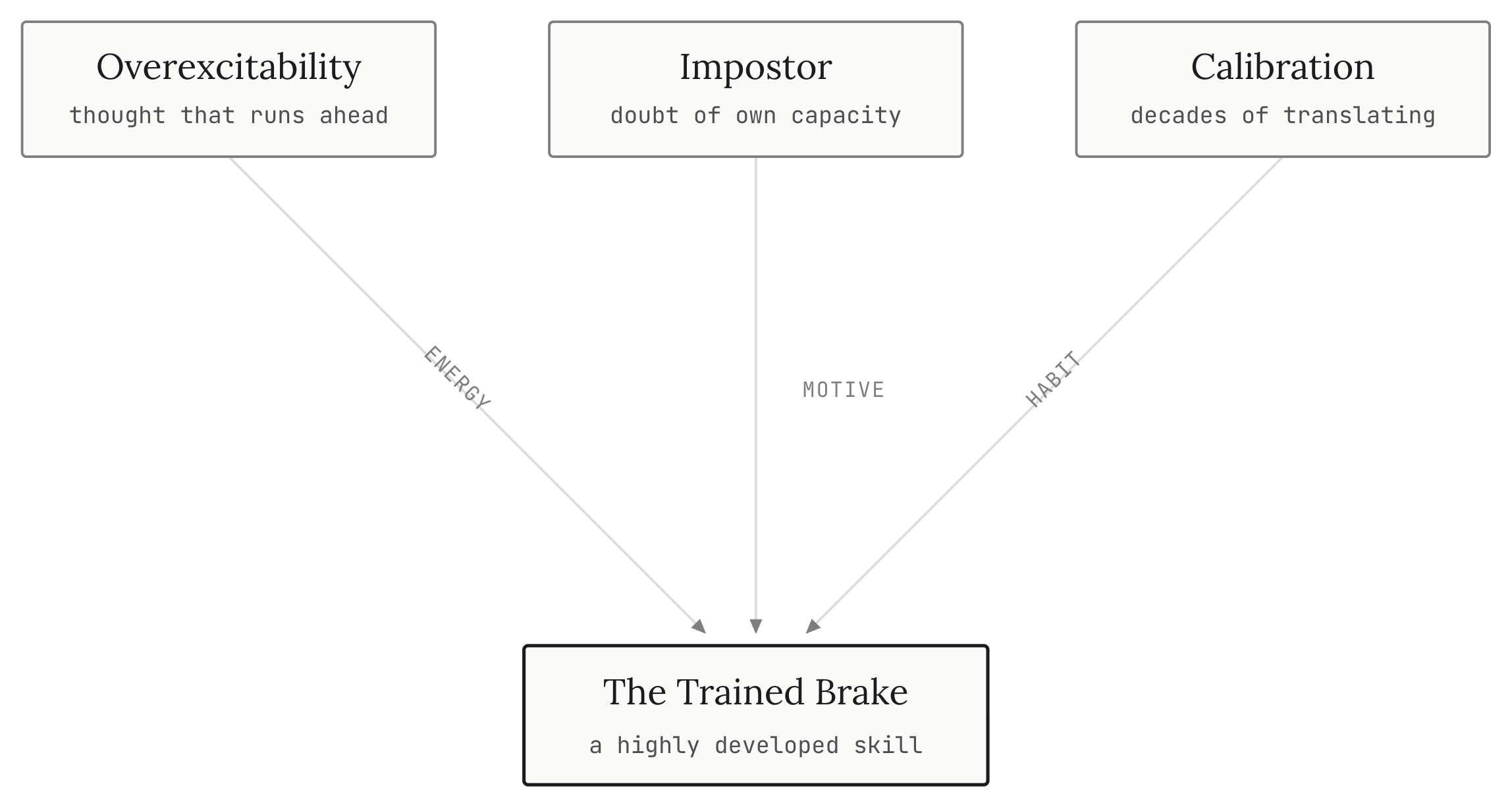
It is tempting to treat them as three separate problems; they are better understood as three contributions to one skill.
Overexcitability — the Energy
Dabrowski described in gifted individuals a heightened intellectual activity he called overexcitability4: a thinking that runs ahead of itself and rarely rests at a first impression. It is not a pathology but a higher baseline — more current through the same system. For the brake, this means the second movement, the overwriting, has a surplus of energy to draw on. Thinking does not stop at the perception; it wants to go further. And “further,” in the absence of a brake on the brake, almost always means: past it. Overexcitability supplies the fuel; it ensures the reading is never left in peace.
The Impostor Phenomenon — the Motive
Clance and Imes described a stubborn distrust of one’s own competence, particularly in people who are demonstrably competent.5 That distrust supplies the brake its motive. The direct apprehension is not distrusted because it goes wrong, but because it is mine — and if I do not trust my own capacity, I certainly do not trust what I saw before I could prove it. The impostor mechanism makes justification compulsory: without evidence it may not be true, and the evidence must come from outside the perception. Every direct reading is thereby rendered suspect until it has accounted for itself — and the overwriting has its justification.
Calibration — the Habit
Calibration, described in “Origin”, supplies the third component: the groove in which the movement runs. Where overexcitability gives the energy and the impostor phenomenon the motive, calibration gives the trained automaticity — the fact that the overwriting does not need to be decided each time anew, but happens of its own accord. It is the habit that turns a possible action into a reflex. Only in combination are the three complete: a reflex that wants to (motive), that can (energy), and that does it without thinking (habit). That is not the sum of three vulnerabilities, but the anatomy of one highly developed skill.
Invisibility
Why the Brake Does Not Show Itself
A skill so thoroughly practised might be expected to be identifiable. But the brake has a property that makes it almost invisible from within: it wears the mask of a virtue. Someone who reasons away a direct perception does not experience themselves as overwriting something. They experience themselves as being careful.
And that is not a self-deception that yields to a single confrontation, because the resemblance is real. The brake resembles nuance: you do not leap at the first impression. It resembles modesty: you do not presume to simply know. It resembles responsibility: you assert nothing without grounds. It resembles rigour: you substantiate before you conclude. Each of these is a property that is rightly valued — socially, professionally, and morally. The brake is therefore not merely tolerated; it is praised. It is a habit defended by your own values.
The brake conceals itself because it resembles a virtue — and is defended by your own values.
This also explains why the usual encouragements do not work. “Trust your intuition” runs into a habit that presents itself as integrity, and no one gives up integrity because they are asked to. Worse: the encouragement itself becomes raw material. Someone who hears that they should trust begins to consider whether they may trust, and that consideration is precisely the brake at work. Every word that encourages the reading invites articulation, and articulation is fuel for the brake. Research into verbal overshadowing points in the same direction: putting an intuitive or perceptual judgement into words can disrupt that judgement rather than capture it.6 The brake does not even need to convince you that you are wrong — it suffices to get you talking.
Scope
Beyond Giftedness
The mechanism has been described here in the context of giftedness, because it manifests there in its sharpest and most visible form. But it is not confined to that one group. The trained brake — the excess of self-monitoring that develops when someone has spent years adjusting their own pace, their own perception, and their own mode of expression in order to fit in — occurs in a wide range of people who see sharply and have long had to translate.
The overlap with other profiles in which lifelong camouflage, assessment, and adjustment became second nature is considerable. Where someone has had to adapt over years to an environment calibrated to a different tempo or a different way of perceiving, the same groove forms: calibrating outward shifts to calibrating inward. This article keeps that observation explicitly descriptive and not diagnostic. It names a mechanism — the trained overwriting of one’s own reading — and not a label; the question of who precisely it reaches is a different question from what it is.
In milder form, moreover, the habit is widespread. Almost everyone knows the moment when something was briefly clear and then, under their own question “but do I really know that?”, closed again. That the mechanism described here might engage more broadly than in those who have developed the reflex most strongly is to be expected — though working that out is a subject of its own. Giftedness is the sharpest case, not the boundary of the phenomenon.
Bridge
What This Means for the Method
If the brake is a trained skill, borne by three developmental forces and defended by one’s own values, then it follows precisely the shape that the earlier article described. A pedagogy of addition cannot relieve this brake; it can only feed it, because every explanation, confirmation, and summary invites the articulation that is its fuel. What remains is a pedagogy of subtraction: not supplying what is missing — nothing is missing — but for a moment not performing a habit that displaces everything else.
From this it also follows why the method relies on proximity and on the group, and not on a speaker. A habit you experience as your own nature cannot be recognised in yourself; you recognise it in someone else doing it, at the moment they do it. When eight people who share the same reflex see one another’s overwriting happen, the brake shifts from truth to movement — from “that’s simply how it is” to “look, there it goes again.” That is not an atmospheric element but the active factor, and it is the reason why the presence of peers accomplishes what no intervention can.
Two articles, one whole. The first described the form; this one described the person for whom the form was made. The brake is not a deficit that the method supplements, but a skill that the method, for the duration of a moment, temporarily suspends. More than that is not needed — and less would not work.
This article is part of a series. Explore the full series here.
Wout and I recorded a conversation on this topic. The conversation is in Dutch.
Kahneman, D. (2011). Thinking, Fast and Slow. Farrar, Straus and Giroux. — The distinction between System 1 (intuitive) and System 2 (deliberative), and the cases in which the latter overwrites the former.
Polanyi, M. (1966). The Tacit Dimension. University of Chicago Press. — “We know more than we can tell”: the notion of tacit knowing and the apprehension that resists full articulation.
Dreyfus, H. L., & Dreyfus, S. E. (1986). Mind over Machine. Free Press. — Expertise as intuitive, holistic pattern recognition; forcing back to rules degrades performance.
Dabrowski, K. (1964). Positive Disintegration. Little, Brown. — Theory of positive disintegration and overexcitabilities, including the intellectual.
Clance, P. R., & Imes, S. A. (1978). The impostor phenomenon in high-achieving women. Psychotherapy: Theory, Research & Practice, 15(3), 241–247.
Schooler, J. W., & Engstler-Schooler, T. Y. (1990). Verbal overshadowing of visual memories. Cognitive Psychology, 22(1), 36–71.
This second part was opened less than the first. Telling, given that it's precisely about skill where others see deficit. I'm leaving it as it stands.