


For years I have been interested in a question that sits underneath many of the discussions we are having about the future of work, organisations, economic growth and social change. We tend to discuss these developments as separate phenomena. We speak about younger generations who relate differently to work, about declining trust in institutions, about sustainability, artificial intelligence, new forms of entrepreneurship and the growing search for meaning. Business responds with new strategies, new leadership models, transformation programmes and, increasingly, new business models. Yet I have come to believe that much of this analysis starts too late in the causal chain. What we observe in society and in business is not the origin of the change. It is its material expression.
My point of departure is that consciousness precedes matter. I do not use consciousness here simply as another word for thought or individual psychology. I mean that the way in which reality is perceived and understood precedes the structures human beings subsequently create within that reality. Values, assumptions about human nature, our understanding of purpose and our perception of our relationship with others and with the world eventually become choices. Repeated choices become behaviour, behaviour becomes organisation, organisation becomes institution, and institutions ultimately constitute a substantial part of the material world in which the next generation finds itself.
The conventional materialist interpretation reverses that direction and regards consciousness primarily as something generated by physical processes. That position remains influential, but it is no longer the only serious intellectual position in the consciousness debate. Contemporary research and philosophy of mind contain active discussions of idealist, dual-aspect, panpsychist and other post-materialist models in which consciousness cannot simply be reduced to an accidental by-product of neuronal activity. Reviews of the mind-brain relationship have explicitly questioned whether correlation between brain states and conscious experience is sufficient to establish that the brain produces consciousness. The matter is far from closed.
For me, however, the significance of this question extends far beyond the philosophy of mind. If consciousness precedes material organisation, a sufficiently profound change in consciousness must eventually become economically and institutionally visible. We should then expect such a transition to appear first at the level of individuals, subsequently within groups and organisations, and ultimately at the level of society itself. In other words, at micro, meso and macro level.
At the micro level this is already difficult to overlook. A growing number of people no longer automatically accept assumptions that for decades were treated as self-evident. A successful life does not necessarily mean a continuously advancing career. More income does not automatically mean greater wellbeing. Growth is no longer universally understood as progress. Status, position and institutional recognition are losing some of their explanatory power. Particularly interesting is that many people are not merely demanding better conditions within existing structures. They are beginning to question the structures themselves.
This distinction matters. An employee asking for more flexibility remains within the existing model and negotiates its conditions. Someone asking why work has been organised in this particular way in the first place is doing something fundamentally different. The first question can usually be answered by HR policy. The second touches the assumptions on which the organisation was constructed.
At the meso level we consequently encounter two movements at the same time. The overwhelming majority of businesses continue to operate within the familiar logic of growth, scale, productivity, competitive advantage, market share, optimisation and return on investment. Even the word transformation usually refers to a process intended to make the existing organisation more capable of continuing: a new strategy, another organisational structure, different technology, a stronger management team or a modified business model. Transformation in this sense does not question the underlying paradigm. It improves the organisation’s ability to function within it.
Academic research into post-growth organisations has begun to make precisely this distinction. Researchers have examined how organisations reproduce the growth assumptions embedded in our economic imagination and what alternative forms of organising might look like. Other work identifies concrete dimensions on which post-growth businesses differ, including their relationship to profit, ownership and incorporation, governance, strategy, size and geographical scope. More recent sustainability research goes further and argues that merely constructing a better “business case” for sustainability can itself perpetuate the dominant organisational logic rather than fundamentally change it.
This is important because it shows that what is often presented as a rather abstract discussion about values is already becoming a question of organisational architecture. A different understanding of value eventually changes what profit means, who owns an organisation, how decisions are made, what constitutes growth, which relationships matter and even whether maximising scale remains desirable.
The transition therefore cannot be understood simply as old companies disappearing and new companies replacing them. For a considerable period both will coexist. Existing organisations possess capital, infrastructure, knowledge, networks, political influence and customers. They can remain commercially successful for decades. Their continued success does not disprove the emergence of another paradigm. It demonstrates the inertia of material structures.
This is where the macro level becomes important. Societies are built from institutions created under assumptions that originated much earlier. Our educational systems contain assumptions about intelligence and learning. Labour markets contain assumptions about productivity and human value. Companies contain assumptions about growth and ownership. Healthcare systems contain assumptions about health. Financial markets contain assumptions about return, risk and time. Once materialised, these structures acquire a life and logic of their own. They do not disappear simply because the consciousness from which they originated is changing.
Research into sustainability transitions has been describing related processes for years. Already in 1982, Kiefer and Senge argued that the transition towards a sustainable society would require shifts in the values and basic assumptions underlying industrial growth and suggested that enterprises could become places where new values are translated into operational principles. Later transition research described the co-evolution of broader societal change and fundamental changes inside businesses. Current research explicitly analyses disruptive business models across micro, meso and macro levels and shows how new models can challenge and eventually reconfigure established regimes.
What interests me is that these different fields are observing parts of the same movement without necessarily giving that movement the same name.
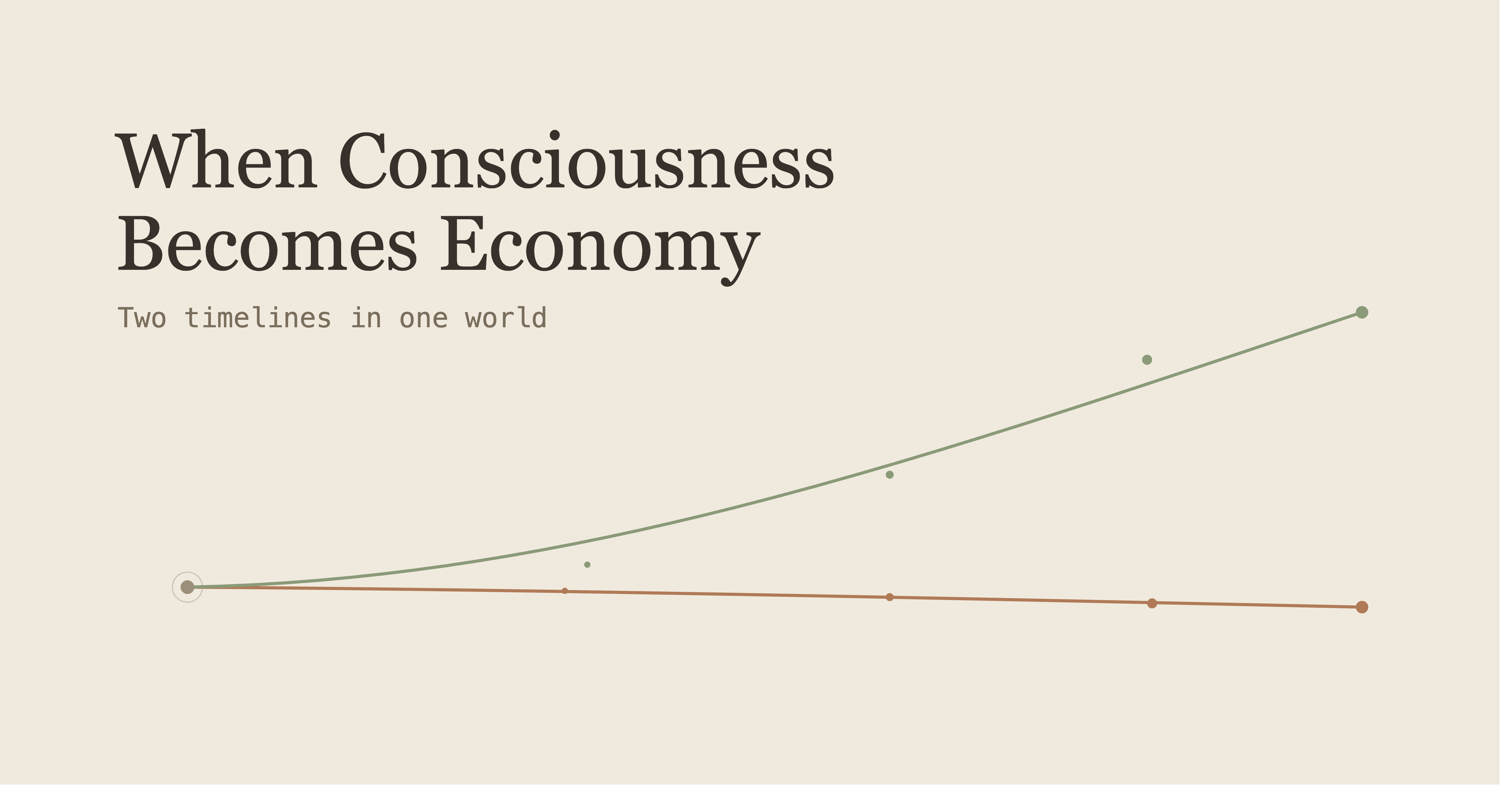
I describe it as the emergence of two timelines.
By this I do not mean two worlds physically separating from one another. I mean two causal trajectories originating in increasingly different states of consciousness and therefore producing increasingly different choices. One trajectory continues the assumptions that have shaped industrial and post-industrial society: expansion, optimisation, control, measurable performance, competition and the continuous conversion of human and natural resources into economic value. The other starts from different assumptions concerning interconnectedness, autonomy, meaning, human development and the relationship between economic activity and life itself.
The crucial point is that these timelines can occupy the same physical world while becoming increasingly incompatible at the level of their underlying logic.
This explains something I have observed repeatedly in organisations and in people. Someone can read an entirely different analysis of society, say that it is fascinating, agree with much of it and even be genuinely impressed by it, without changing a single consequential decision. Intellectually understanding another paradigm is not the same as operating from it. Information can enter the existing consciousness and simply be incorporated into the existing worldview. Nothing material changes because nothing fundamental in the causal chain has changed.
That is why I have become increasingly uninterested in what people say they understand. I look at what follows from that understanding.
What choices are made? What is no longer pursued? What becomes important that previously was not? What relationship with money changes? What happens to ideas about status, career, ownership, leadership and growth? Which structures are subsequently created?
If nothing changes there, the information may have been understood cognitively, but it has not produced a transformation in consciousness.
This is also why I believe businesses are making a mistake when they interpret what is happening primarily as a changing market. They observe new consumer preferences, labour shortages, younger employees with different expectations, sustainability demands, distrust of established institutions and rapidly changing technology. Each phenomenon receives its own consultancy report and its own strategy. Yet it is possible that these are not independent variables requiring separate managerial responses. They may be different material consequences of a deeper transition.
If that is the case, organisations cannot solve it simply by becoming better versions of themselves.
There is nothing wrong with a company improving its sales organisation, professionalising management, introducing artificial intelligence, strengthening its brand or pursuing international growth. Such companies may remain highly successful. The mistake is to confuse successful optimisation within one paradigm with understanding the transition between paradigms.
That transition will generate different business cases because it must. Once the assumptions about value change, the economic structures expressing those assumptions eventually change as well. We are already seeing serious research into post-growth enterprises, alternative governance, regenerative business, stakeholder models and organisations deliberately limiting scale or redefining their relationship with profit. None of these models individually constitutes the new economy. They are early material manifestations of a much broader search. Research itself acknowledges that there is not yet one settled model for what a post-growth company should be.
I consider that uncertainty meaningful rather than problematic. If consciousness really does precede matter, the next economic paradigm cannot be completely designed using the conceptual instruments of the previous one. We will recognise parts of it only as people begin living differently, making different choices, entering into different relationships and subsequently building structures that correspond with those choices.
This also means that the split will become more visible before it becomes less visible. Organisations operating from different underlying assumptions will increasingly struggle to understand one another. The same applies to individuals. They can use identical words — growth, purpose, transformation, sustainability, freedom — while meaning fundamentally different things by them. Cooperation remains possible at a transactional level, but becomes considerably more difficult when it requires a shared understanding of what the activity itself is ultimately for.
The mistake would be to turn this into a moral distinction between good and bad people or enlightened and unenlightened businesses. That is far too simple. The existing economic paradigm has produced extraordinary knowledge, prosperity, infrastructure and technological capacity. Nor will it suddenly cease to exist. The relevant question is whether the consciousness from which that paradigm emerged is still capable of producing adequate answers to the conditions it has itself helped create.
Increasingly, I think it is not.
And that is why I do not primarily look at the current period as an economic, technological or political transition. Those are the visible layers. Underneath them lies a transition in consciousness, and because consciousness precedes matter, that transition is now beginning to acquire physical, organisational and economic form.
At first the manifestations are small and easy to dismiss. A person makes an unusual choice. A career is abandoned. A company refuses an obvious growth opportunity. A different form of ownership appears. A place is created for reasons that do not fit neatly into an existing business category. New relationships form between work, meaning, community and economic survival.
Individually these examples prove very little.
Collectively they begin to reveal a direction.
The interesting question for the coming years is therefore not whether the old economy will survive. Of course it will. Nor is the question whether every new initiative will succeed. Many will not.
The question is what happens when a change that began in consciousness has had sufficient time to become matter.
I think we are beginning to find out.