


This article describes a didactic model that reverses the classical teaching situation — teacher, content, learner — at every corner. The model is not designed to transfer knowledge but to disarm an acquired habit: the tendency of deeply perceptive people to reason their direct perception back into defensibility after the fact. Central to the argument is the claim that this tendency grows stronger the more gifted a person is, and that the standard instruments of good teaching — explanation, confirmation, structured build-up, summary — feed precisely that tendency.
The model is grounded in three established traditions: the classical didactics tradition and the didactic triangle, research on tacit knowledge and expert intuition, and the psychology of giftedness. The article argues why the design is structurally unique and why it works particularly well with gifted adults, while acknowledging that the mechanism reaches beyond that group. A separate section describes the six capacities a facilitator must hold to carry the model. The discussion names the limits plainly: dependence on the facilitator, the risk of overestimating intuition, and the measurement paradox that follows from the model’s resistance to demonstrable outcomes.
Introduction
The Problem That Is Not a Deficit
Almost all didactics starts from a deficit. There is something the learner does not yet know or cannot do, and the teaching situation is designed to fill that gap. Whether the filling happens through direct instruction, active learning, discovery, or personalised support — the direction is the same: from those who have it to those who lack it. The pedagogical imagination is largely an imagination of addition.
The model described here is designed for a population in which that assumption does not hold. Gifted adults rarely lack knowledge. What characterises them is rather a surplus: a capacity to see quickly and directly, coupled with an equally strong capacity to immediately distrust that seeing and demand its justification. The problem is not that something is missing but that something is running too hard. A pedagogy of addition feeds precisely the mechanism it is meant to relieve.
The proposal is therefore a pedagogy of removal: a model in which the highest skill of the facilitator is restraint, and in which success is deliberately understood as small and unspectacular. This article sets out that model, roots it in existing theory, and examines two questions: why is it structurally unique, and why does it work particularly with gifted people?
The Paradox
When the Gift Becomes the Lock
The core of the model is a single mechanism. Someone who sees something directly — a direction, a judgement, an it’s here that arrives before any reasoning — has learned to distrust that grip. Not because they are often wrong, but because they cannot immediately justify it. So they reason it back into defensibility afterwards. The gift becomes its own lock: the instrument that sees fastest is also the one most quickly overwritten.
What makes this insidious is that the overwriting grows with the giftedness. The more cognitive power a person has, the more convincing the counter-argument they can mount against their own simplicity. The brain argues against its own directness with more force the more gifted the person is. The capacity that should serve direct perception turns against it.
The gift becomes the lock: the instrument that sees fastest is also most quickly overwritten.
This maps precisely onto the psychology of fast and slow thinking. In the distinction between a fast, intuitive system and a slow, reasoning one1, the back-reasoning described here is a case in which the reasoning system does not supplement a healthy direct impression but overwrites it. That is not always harmful — reasoning often corrects an unreliable impulse. But when someone’s direct impression rests on years of trained pattern recognition, overwriting it out of habit is the problem, not the solution.
Why does this affect gifted people in particular? Three threads from the literature converge here. First, the heightened intellectual activity that Dabrowski described as overexcitability2: a mind that runs past its first impression by default. Second, the impostor phenomenon3: a stubborn distrust of one’s own competence, precisely in people who are competent. And third, what practice calls dosing — decades of diverging from the norm, translating for others, and permanently calibrating how much one’s environment can handle. Whoever has had to dose for that long has made the justification of their own perception second nature. The brake is not a flaw; it is a highly trained skill.
From this follows the single rule of the model, and simultaneously the standard by which every action within it is measured: no intervention may supply the back-reasoning with fuel.
Model I
The Reversed Didactic Triangle
In the classical tradition of didactics — from Comenius through Herbart to Klafki4 — the teaching situation is modelled as a triangle with three poles: teacher, content, and learner. The pedagogical movement classically runs from the teacher, via the content, to the learner. That is transfer. Almost all innovation within this tradition redistributes the weights within that movement — activating the learner, redesigning the content, changing the role of the teacher — but leaves the direction of transfer intact.
The model proposed here does not redistribute; it reverses the direction. At each corner the function of the pole changes, and the movement of transfer disappears. What remains is not an empty triangle but a fourth relation that is incidental in the classical model and becomes the actual instrument here: the relation between participants with one another.
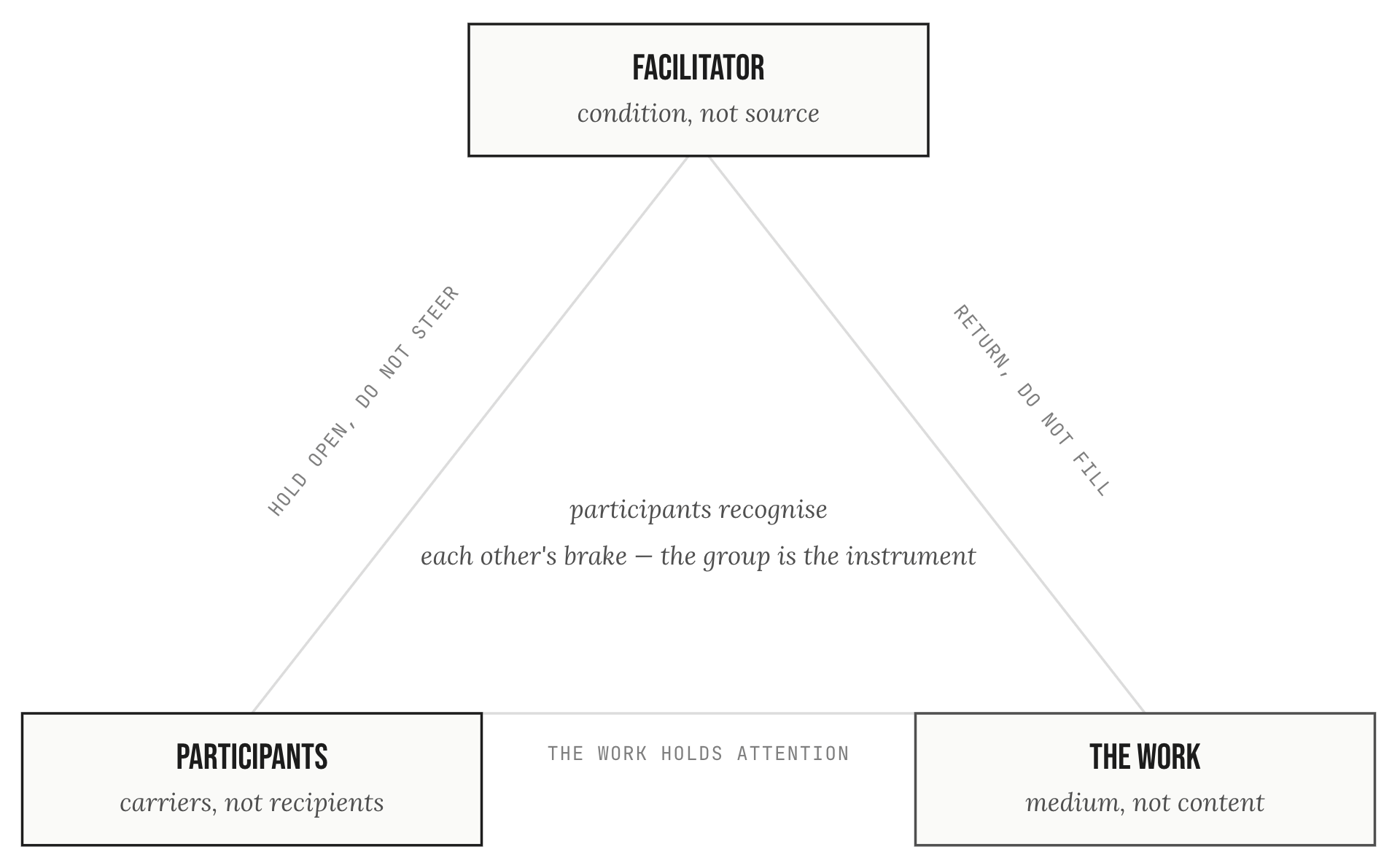
The reversal at each pole is precise. The participant is not a recipient but a carrier: the direct seeing is already there, they have simply unlearned how to let it stand. The work is not content but a medium: it prescribes no subject matter but occupies attention, giving thinking something to do while the brake becomes visible. The facilitator is not a sender but a keeper of the space: a condition under which something can remain standing, not a source from which something flows. And the fourth relation carries the weight: because everyone present shares the same reflex, they recognise it in each other as a movement — as something a person does — rather than as truth in itself.
Model II
The Didactic Dimensions
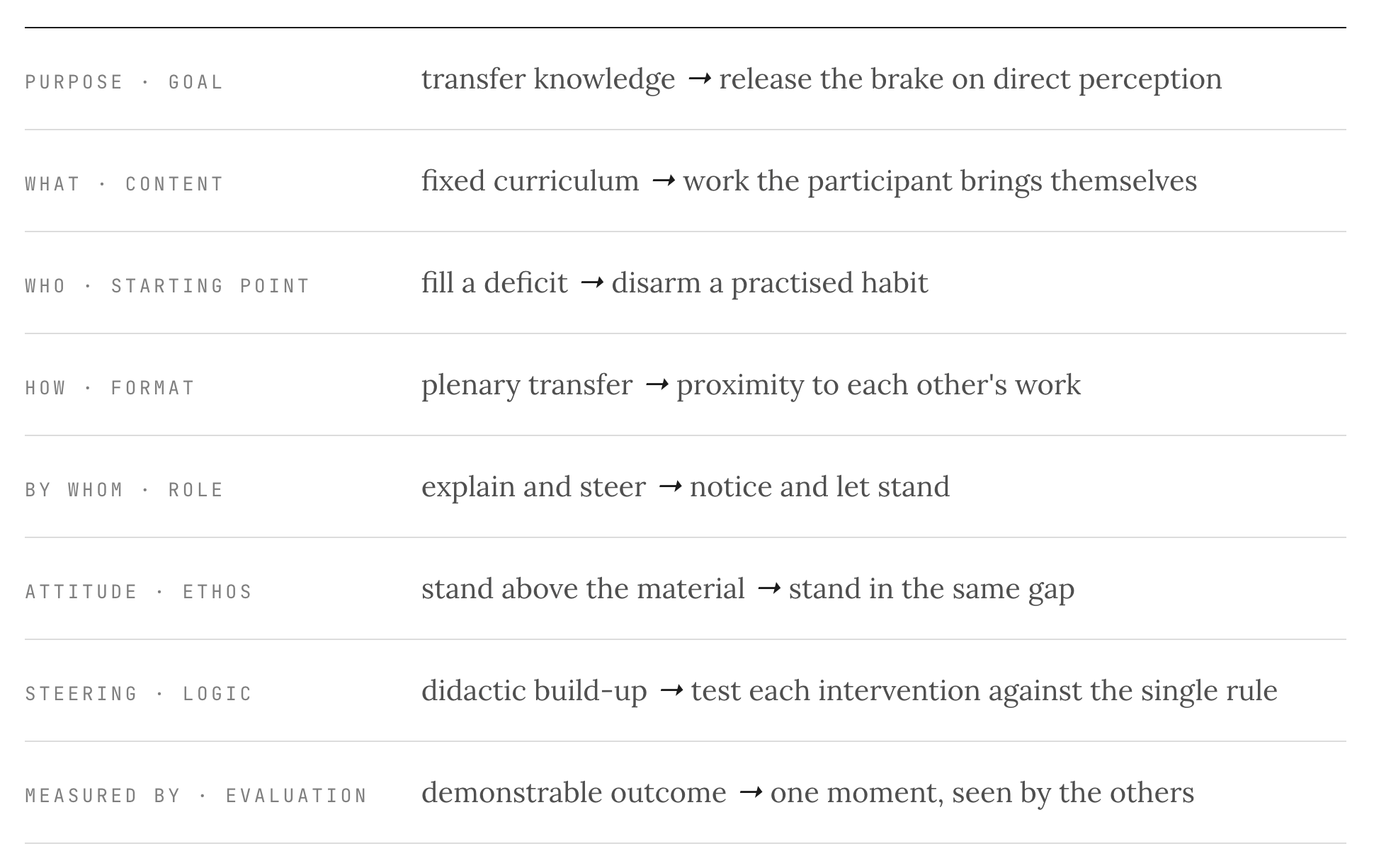
The reversal can be mapped along the classical didactic questions. Each question receives not a different answer but a reversed form. The dimension map below fixes the axes along which a session is structured — not what goes into it.
The prohibition on articulation
Two dimensions — purpose and format — find direct support in the literature on tacit knowledge and expert intuition. Polanyi captured it in the claim that we know more than we can tell5: an essential part of competence is implicit and cannot be fully put into words. Dreyfus and Dreyfus showed that the expert does not act from explicit rules but from fluid, holistic pattern recognition, and that forcing them back into rules can reduce an expert’s performance to that of an advanced beginner.6 Research on so-called verbal overshadowing points in the same direction: articulating an intuitive or perceptual judgement can disrupt rather than fix that judgement.7
This gives the central intervention rule an empirical foundation. The demand that a direct perception be justified before it may exist is not a neutral didactic step; it initiates the articulation that can damage the direct impression. This is why the model classifies explanation, confirmation, and summary not as helpful but as risky: all three invite articulation, and articulation is fuel for the brake.
The facilitator as condition
The role and attitude dimension connects to the non-directive, person-centred tradition of Rogers8, and to the older idea of a negative education — in Rousseau the thought that the educator sometimes primarily removes obstacles rather than adds anything.9 The model stands in that lineage but takes one step further than common facilitative practice. Where Rogers places unconditional positive regard at the centre, this model treats even confirmation as an intervention that adds a layer: whoever hears that their perception is correct is given something to fall back on, and that falling back is precisely the problem. The strongest action of the facilitator is therefore often silence — not as technique, but because any filling closes the space the model holds open.
Originality
Why This Model Is Distinct
The model is easy to confuse with neighbouring approaches, and the distinction is sharpest when named directly. Learner-centred education places the learner at the centre and lets them construct knowledge themselves, but still presupposes something being built or acquired — there is an outcome that grows. Rogerian facilitation and coaching work non-directively but aim for growth, insight, or breakthrough — addition in different packaging. Socratic dialogue draws out thinking but steers toward a conclusion. In all these cases the pedagogy remains one of addition, and the closure — the insight, the summary, the breakthrough — remains the proof that it worked.
What elsewhere counts as proof of success — the closure — is here the proof of its failure.
What distinguishes this model is that it reclassifies that same closure as a symptom of failure. Every action that elsewhere qualifies as good teaching — explaining, confirming, building toward insight, summarising at the end — is tested against the single rule and typically falls outside it, because it feeds the back-reasoning. What remains is a didactics of removal: the highest action is restraint, and a successful session may end unfinished. The evaluative measure is deliberately modest — one direct perception that was allowed to stand, seen by the others — and a conclusion would betray the model. That sustained, structural consistency — a single rule that disqualifies all standard interventions — is what makes the model rare, not its individual ingredients.
Target Group
Why It Works Precisely with Gifted People
The fit with gifted adults is not coincidental but follows from the design. Three reasons.
First, the model assumes no deficit. A pedagogy of addition assumes a gap; with this population there is no gap but a surplus of justificatory capacity. By not adding but disarming, the model does not feed that surplus. An approach that would explain, confirm, or summarise would give the counter-argumentation precisely the fuel it is asking for — and the more gifted the participant, the more such an approach backfires.
Second, it engages the specific burden of giftedness, not a general learning process. The heightened intellectual activity10, the distrust of one’s own competence11, and years of dosing together constitute a highly trained brake. The model treats that brake not as a character trait but as a habit — as something a person does and can therefore temporarily not do — and makes it visible through the group. That the other participants share the same reflex is not a mood element but the active factor: one recognises in the other what one holds as truth in oneself.
Third, it temporarily suspends the dosing. Gifted adults rarely encounter intellectual peers; the people with whom no translation is needed are scarce. A small, carefully composed group of peers in which diverging does not have to be dosed is already unlocking in itself — independent of any didactic intervention. This explains why proximity is the medium here and not the content: the presence of peers does the work that a speaker cannot do.
Although the model is described here around giftedness, the mechanism it addresses is not limited to one group. The trained brake — the surplus of self-monitoring that develops when someone has had to adjust their own pace, perception, and expression for years in order to fit in — appears across a range of people who see sharply and have had to translate for long. Giftedness is the sharpest and most visible case of this, not the only one; the overlap with other profiles in which lifelong camouflaging and calibrating has become second nature is considerable. In milder form, the habit of prematurely reasoning away one’s own perception is also widespread. That the model may therefore reach further than those in whom the reflex is strongest falls outside the scope of this article — but it is not a far-fetched thought.
The Facilitator
The Capacities Required to Hold It
A model that asks the facilitator not to explain, not to confirm, and not to summarise places unusual demands. Almost every training for trainer, teacher, or coach cultivates precisely the opposite reflexes: structuring, clarifying, reassuring, closing. The facilitator of a reversed didactic model must not lack those reflexes but be able to hold them back — which makes the required capacities more a matter of disposition and restraint than of technique. They resist reduction to a protocol; below are the six that carry the model.
Restraint — the negative capability. The most difficult capacity is the absence of action at the moment when every ingrained reflex pushes toward it. It is what the poet John Keats called negative capability12: the ability to remain in uncertainty and incompleteness without reaching hurriedly for fact and resolution. Concretely it means not filling the silence, tolerating the unfinished session, and resisting the social pressure to remove someone else’s discomfort. Whoever cannot do this reasons — out of their own unease — the space back closed that the model holds open.
Reading the brake. The facilitator must distinguish in real time when someone is letting something direct stand and when they are already reasoning it back closed. That distinction cannot be captured in rules; it is itself a form of the expert intuition the model protects in the participant — holistic pattern recognition13, not a checklist. The facilitator recognises the movement of closing while it is happening, often from tone, pace, and word choice rather than content.
Knowledge of one’s own brake. The facilitator shares the reflex they are disarming, and there — not in the group — lies the first point of failure. They must know their own tendency to explain, confirm, and be brilliant from the inside, because that tendency ambushes them in the moment and because recognising it in others rests on recognising it in oneself. This requires reflection-in-action14: the capacity to notice one’s own impulse as it arises and let it pass rather than execute it.
The opening question. When the facilitator does intervene, their strongest instrument is a question that opens rather than tests. Such a question points without leading, delivers no content, and invites no defence — unlike the Socratic question, which steers toward a conclusion. The skill lies in precision and timing: placing the question where no one has yet looked, and at the moment that matters, not before.
Double attention — the group as instrument. Because the fourth relation does the work, the facilitator must remain simultaneously in contact with the individual and the group, and hold the proximity such that participants begin to recognise each other’s brake. This includes bringing attention back to the work when it drifts toward talking about — without making that return itself an intervention that feeds the machine.
Seniority without ego. The facilitator needs enough authority to remain unmoved when the group asks for steering, and enough ego control not to display that authority. Those who know a great deal are tempted to show it; but confirmation and wit feed the facilitator’s ego and the participant’s brake in equal measure. The seniority serves the holding; the absence of ego serves the non-transferring.
These six are foundational dispositions that ripen through practice and reflection, not skills that can be fixed in a manual. That is not a detail: it is the reason the model is facilitator-dependent and scales poorly — a point the next section names as a limit.
Discussion
Limits and Open Questions
An honest assessment requires equal attention to what the model does not do and cannot claim.
There is a built-in measurement paradox. The model defines success as the absence of closure and resists demonstrable outcome. That same quality makes formal evaluation difficult: what evades conclusions also evades measurement. Anyone wishing to assess the model is therefore dependent on indirect measures — for instance, the moment a perception remains standing undefended — without reintroducing the closure the model excludes.
There is a risk of overestimating intuition. The model privileges the unguarded impression, but not every direct grip is correct; sometimes the back-reasoning is a legitimate correction. The model deliberately sidesteps this question of truth — it measures whether something was allowed to stand, not whether it was right. That is defensible as a demarcation, but it means the model explicitly makes no judgement about the accuracy of what it protects. Whoever reads the model as a plea against reasoning reads it wrong: it targets the premature, habitual closing-down, not examination where appropriate.
The model is facilitator- and selection-dependent. It requires a facilitator who knows the reflex from the inside — who stands in the same gap — and who can sustain the restraint described in the previous section where the impulse to intervene is strong. Those capacities are a matter of disposition and resist reduction to a protocol, making the model difficult to standardise and scale. Additionally, the groups rest on careful composition, which further complicates generalisation. The reach of the model is therefore, even in its own terms, narrow — and that is a design choice rather than a flaw.
Conclusion
A Form, Not a Script
The model describes a form, not a content and not a sequence. It turns on a single mechanism — the back-reasoning of a direct grip — and a single rule: no intervention may feed that mechanism. From that follow the reversed triangle and the eight dimensions, and from that follows the modest measure by which a session is assessed.
What is structurally distinctive is that the model does not adjust the pedagogy of addition but reverses it into a didactics of removal, and that it reclassifies the standard proofs of successful teaching as risks. That it engages precisely with gifted adults is not incidental: with them the problem is not a deficit but a surplus, and a model that adds nothing is the only one that does not feed that surplus. It is finished when it makes itself unnecessary.
In Practice
Where This Happens
The model is described here as a form, but it did not emerge as a theory; it comes from a practice and is carried within it. That practice is called the Werktage (German for “workday”): two days in Berlin, a small group, in which participants bring real work and work on it in each other’s proximity. What this article writes out as structure — no transfer, no summary, no closure, and one direct perception that was allowed to stand — is there not a description but the way things go.
The NEXUS Werktage is therefore the place where the form is lived rather than explained, and at the same time the source from which the reflection in this article is drawn. Whoever wants to see the model work will see it there; this section need not claim more than that.
This article is part of a series. Explore the full series here.
Wout and I recorded a conversation on this topic. The conversation is in Dutch.
Kahneman, D. (2011). Thinking, Fast and Slow. Farrar, Straus and Giroux. — The distinction between System 1 (intuitive) and System 2 (reasoning).
Dabrowski, K. (1964). Positive Disintegration. Little, Brown. — Theory of positive disintegration and overexcitabilities, including the intellectual.
Clance, P. R., & Imes, S. A. (1978). The impostor phenomenon in high-achieving women. Psychotherapy: Theory, Research & Practice, 15(3), 241–247.
Klafki, W. (1985). Neue Studien zur Bildungstheorie und Didaktik. Beltz. — On the Didaktik tradition and the didactic triangle (teacher–content–learner), with lineage to Comenius and Herbart.
Polanyi, M. (1966). The Tacit Dimension. University of Chicago Press. — “We know more than we can tell”: the notion of tacit knowledge.
Dreyfus, H. L., & Dreyfus, S. E. (1986). Mind over Machine. Free Press. — Model of skill acquisition; expertise as intuitive pattern recognition.
Schooler, J. W., & Engstler-Schooler, T. Y. (1990). Verbal overshadowing of visual memories. Cognitive Psychology, 22(1), 36–71.
Rogers, C. R. (1969). Freedom to Learn. Merrill. — Non-directive, person-centred approach to learning.
Rousseau, J.-J. (1762). Émile, ou De l’éducation. — The idea of negative education: removing rather than adding.
See note 5.
See note 6.
Keats, J. (1817). Letter to George and Thomas Keats, 21 December 1817. — The notion of negative capability: remaining in uncertainty without reaching for fact and resolution.
See note 3.
Schön, D. A. (1983). The Reflective Practitioner. Basic Books. — Reflection-in-action: the professional who notices their own impulse in the moment.