


Four earlier articles described the form, the person, the need, and the price: an inverted didactic model, the brake as a trained skill, the reasoned-away need for recognition without translation, and the bill that a lifetime of translating builds up. All four were description. This final article describes what those descriptions were pointing toward: the encounter itself — what happens when someone with great intellectual power finds themselves, among equals, seen for the first time without having to translate.
The argument is that this is not a change and nothing to be learned. Nobody is restored and nobody is improved; understanding comes naturally to these people. What takes place is recognition, and recognition is an event, not an achievement. I describe what happens — the brake falls silent — why it requires a group of equals and cannot be provided by a single person, why the same intellectual power that made the brake so forceful is here precisely what carries the encounter, and, emphatically, what does not happen: no breakthrough, no cure. What remains is smaller and more lasting: the certainty, from experience, that the situation exists.

Reversal
What Occurs, Not What You Learn
Four articles described the brake and everything around it: its form, the person who carries it, the need it conceals, the price it demands. They were descriptions, and descriptions point somewhere. What they pointed to is an event — one that can no longer be described without it becoming clear that it is no longer a description. This article is about the encounter itself.
The common assumption is that a gathering of such people serves some purpose: that you learn something there, that you change, that something is being worked on. That assumption comes from a world in which every gathering must have a goal and every discomfort a solution. But there is nothing to learn here. Understanding comes naturally to those who have the intellectual capacity; that was never the problem.
There is nothing to learn. Understanding always came naturally — the situation in which it does not have to, did not.
What was missing was not insight, but the one situation in which the insight does not first need to be translated. This article departs from that reversal: the value of the encounter lies not in change, but in recognition — and recognition is not something you bring about, it is something that happens to you.
The Phenomenon
The Brake Falls Silent
Describe the moment. You say something — or you say nothing — and for once the second movement does not come. The half-second passes without overwriting, because there is nothing to defend: the other person has already seen it, in the same grasp, at the same instant, without it needing to be put into words.1 The brake, which ran uninterrupted for decades, is suddenly idle.
Idle, not switched off — a skill cannot be turned off. But for the first time, nothing is being asked of it. The image from the third article, of the long car journey in which little needs to be said and yet everything is understood, is here no longer a longing but a fact in the room.2 Those who experience it for the first time often only realise afterwards what had been missing: the constant background labour of translating, which is now briefly at rest.
The Group
Why Recognition Requires Equals
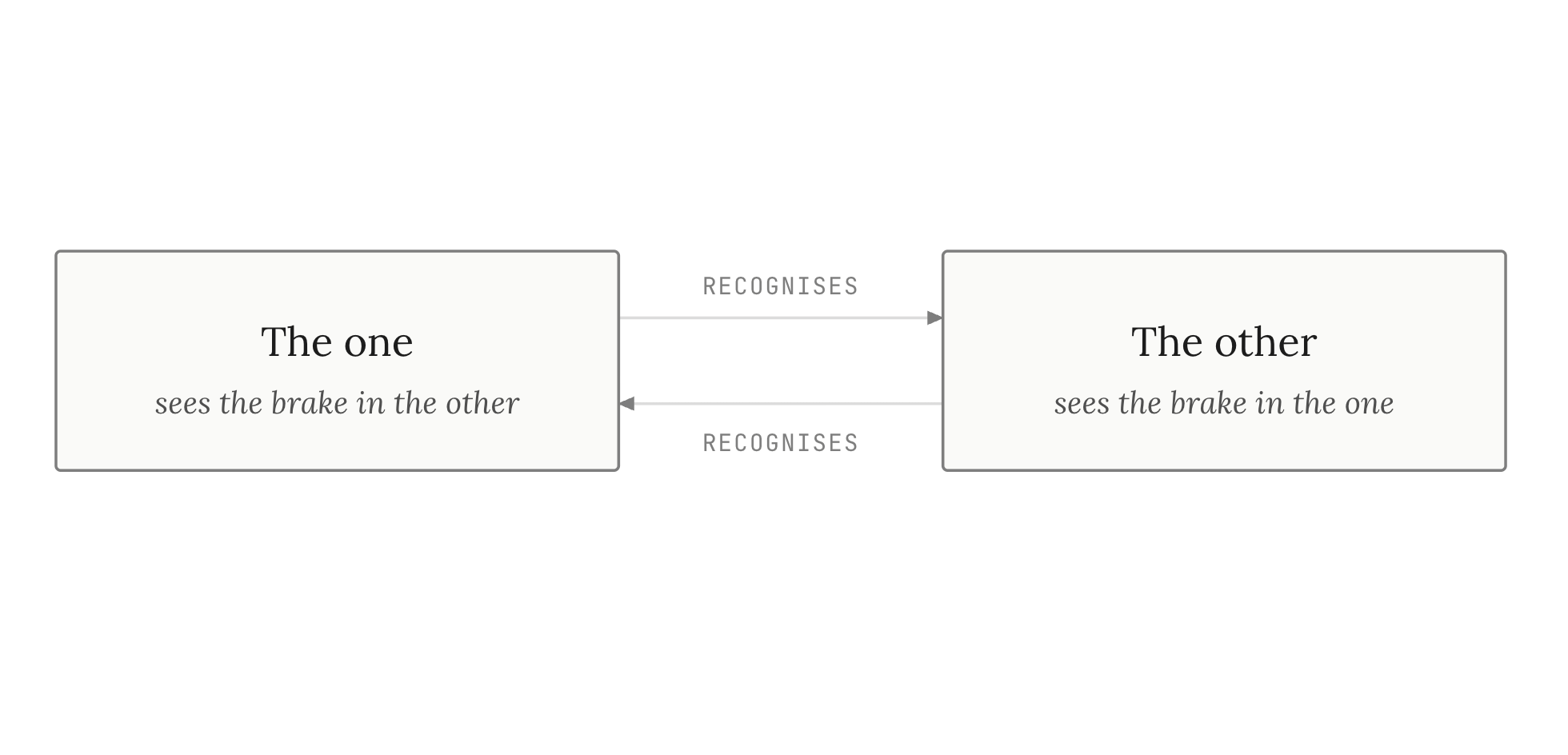
This cannot be provided by one person, and the third article already said why: a role calls for translation, and translation is precisely what must fall away. But there is a second, more positive reason, and it only becomes visible in the event itself. Recognition is reciprocal. You are not recognised the way you are helped — by someone who does something — but in the same movement in which you yourself recognise. Philosophy knows this as the structure of recognition: a person comes to themselves only in being seen by another whom they also see.3
That is why the group is not an audience and not a circle of support. It is a collection of instruments reading one another. Each one sees the brake moving in the other — or, here, falling silent — because each one knows it from within. One person can comfort you; only an equal can recognise you. And because it happens mutually and simultaneously, it is not a service rendered but an event that takes place: between people, in what Buber called the between — the real encounter, which lies not in the one or the other but in what arises between them.4
That also explains why it is unpredictable. Put eight such people together and nobody — the facilitator included — knows in advance where it will go; the only thing that is certain is that nothing needs to be translated. The facilitator creates the situation and holds it, but does not provide the recognition. That happens, or does not happen, between equals.
Amplification
Why the Same Intellectual Power Here Works for You
In the three preceding articles, intellectual power was always the adversary: it provided the most convincing grounds for overwriting the perception, denying the need, booking the price as a virtue. Here that reverses. The same instrument that overwrites most quickly also recognises most quickly. The depth that allowed you to reason your way past your own knowledge means that you grasp another person’s knowledge in a single movement.
That is why the encounter works better the greater the intellectual power, and why the group must be at the same level. Among equals, the intellectual power does not need to be held back; for the first time it is not rationed. What for decades was a burden — too fast, too deep, too much for the room — is here precisely what carries the recognition. The brake does not fall silent despite the intellectual power, but because it finally no longer needs to be reined in.
The same instrument that overwrites most quickly also recognises most quickly.
What Does Not Happen
No Breakthrough, No Cure
It is important to say what the encounter is not, precisely because the world these people come from immediately turns every experience into a product. There is no breakthrough. Nothing is cured. The brake is and remains a skill; tomorrow it will run again, in a world that still demands translation. Those who expect a transformation will be disappointed — and rightly so, because that promise would itself be a new form of translating.
What changes is smaller, and for that very reason more lasting. The need that was reasoned away in the third article has been answered once, and that can no longer be denied. You now know, not from reasoning but from experience, that the situation exists in which it is not required — that you can be seen as you are, without condition.5 That is not a cure. It is the end of a particular kind of doubt: the doubt as to whether the longing was real. That certainty is not lost again, even when the brake runs again tomorrow.
No cure. The end of the doubt as to whether the longing was real.
Scope
Beyond Giftedness
The encounter itself is nothing exotic. Being seen without having to translate is the most ordinary human experience there is — two people who understand each other without explanation. What has been described here around giftedness does not make that experience special, only rare: for those who have had to translate all their lives, the ordinary has become exceptional.
Like the previous four, this article keeps its observations descriptive. It names an event, not a method with a guaranteed outcome and not a treatment. Whether recognition takes place depends on the people in the room, not on a technique. In a milder form almost everyone knows it: the moment when someone understands you before you have finished speaking, and you notice that you were holding a breath you did not know you were holding.
Close
What the Five Together Describe
Five articles, one movement. The form gave the place. The person gave the carrier. The need gave the ground. The price gave the stakes. And the encounter gives the only thing that is no longer a description: the moment when the brake, for the first time, does not need to work. Everything before it was necessary in order to be able to recognise that moment when it arrives.
With that, what the Werktage are — and what they are not — has also been said. They teach you nothing, they do not change you, they repair nothing — because nothing was broken. They create one situation: the one in which it is not required. That is all they do, and less would leave the need untouched. The brake was never the problem. The problem was that it was never allowed to fall silent anywhere.
This article is part of a series. Explore the full series here.
Wout and I recorded a conversation on this topic. The conversation is in Dutch.
Polanyi, M. (1966). The Tacit Dimension. University of Chicago Press. — Tacit knowledge: what is recognised does not need to be put into words.
Reis, H. T., & Shaver, P. (1988). Intimacy as an interpersonal process. In S. W. Duck (Ed.), Handbook of Personal Relationships (pp. 367–389). Wiley. — Being understood as the core of a nourishing bond.
Honneth, A. (1992). Kampf um Anerkennung. Suhrkamp. — Recognition (Anerkennung) as the structure in which a person comes to themselves only through the other.
Buber, M. (1923). Ich und Du. Insel Verlag. — The real encounter (Begegnung) and the between: what lies not in the one or the other, but arises between them.
Rogers, C. R. (1957). The necessary and sufficient conditions of therapeutic personality change. Journal of Consulting Psychology, 21(2), 95–103. — Being seen without condition.