


The first five articles described the price of perceiving more sharply than the surroundings can name: the brake, the reasoned-away need, the lifelong translation. This article turns the gaze around. Not what it costs, but what actually happens. It describes one movement in two directions — reading and holding — and shows that a career that seemed to consist of two tracks was in reality that one capacity, directing itself now at an organisation, then at a person.
The Reading
There is a form of perceiving that is not a sum of parts. Most people understand a system — an organisation, a conversation, a society — by looking at the parts one by one and then connecting them. There is also a perceiving in which the parts do not come one by one, but simultaneously, and in which the structure is already there before the individual components have been named. That is not sensitivity and not intuition. It is a way of knowing that begins at the structure rather than arriving at it.
Someone who perceives this way does not see more details than anyone else. They see the relationship between the details before the details have been counted. In a conversation, that is the real question beneath the question asked. In an organisation, it is the line along which power actually runs, independent of the org chart. In a society, it is the movement taking shape before it has a name. It is always the same thing: seeing the form before the content has been filled in.
They do not see more details than anyone else. They see the relationship between the details before the details have been counted.
That this is rarely recognised as a capacity is because it does not feel like an achievement from the inside. It costs no effort; it happens by itself. What costs effort is the opposite — waiting until another person has worked through the parts one by one, and acting as though you had not already seen the outcome. Most people who perceive this way have spent years learning to do the second. They have not developed the reading; they have learned to conceal it.
The Holding
Reading alone changes nothing. Seeing the structure is the first movement; the second begins when someone sits across from you who carries that same structure — in their work, their organisation, their life — but cannot yet put it into words themselves. Then something arises that is harder to name than the seeing: you hold the structure. Not to transfer it, but to keep it upright in the space between you until the other person can see it themselves.
Holding is different from explaining. Explaining means: I have the answer and I give it to you. Holding means: I see the form you are carrying, I am not naming it for you yet, I am keeping it still so that it does not slip away while you approach it yourself. The difference is not politeness.
A structure you fill in for someone remains yours. A structure they reach themselves becomes theirs. Only the second changes anything.
This is the part that appears in no job description. It cannot be measured and it does not claim itself. To an outside observer, whoever is doing it appears to be doing very little — a conversation, a question at the right moment, a silence that is not filled. But it is the actual work. The seeing happens by itself; the holding is what makes it usable for someone else. It is precisely what the two days of the NEXUS Werktage revolve around, and what the work with individuals revolves around: not transferring what I see, but holding what the other person already carries.
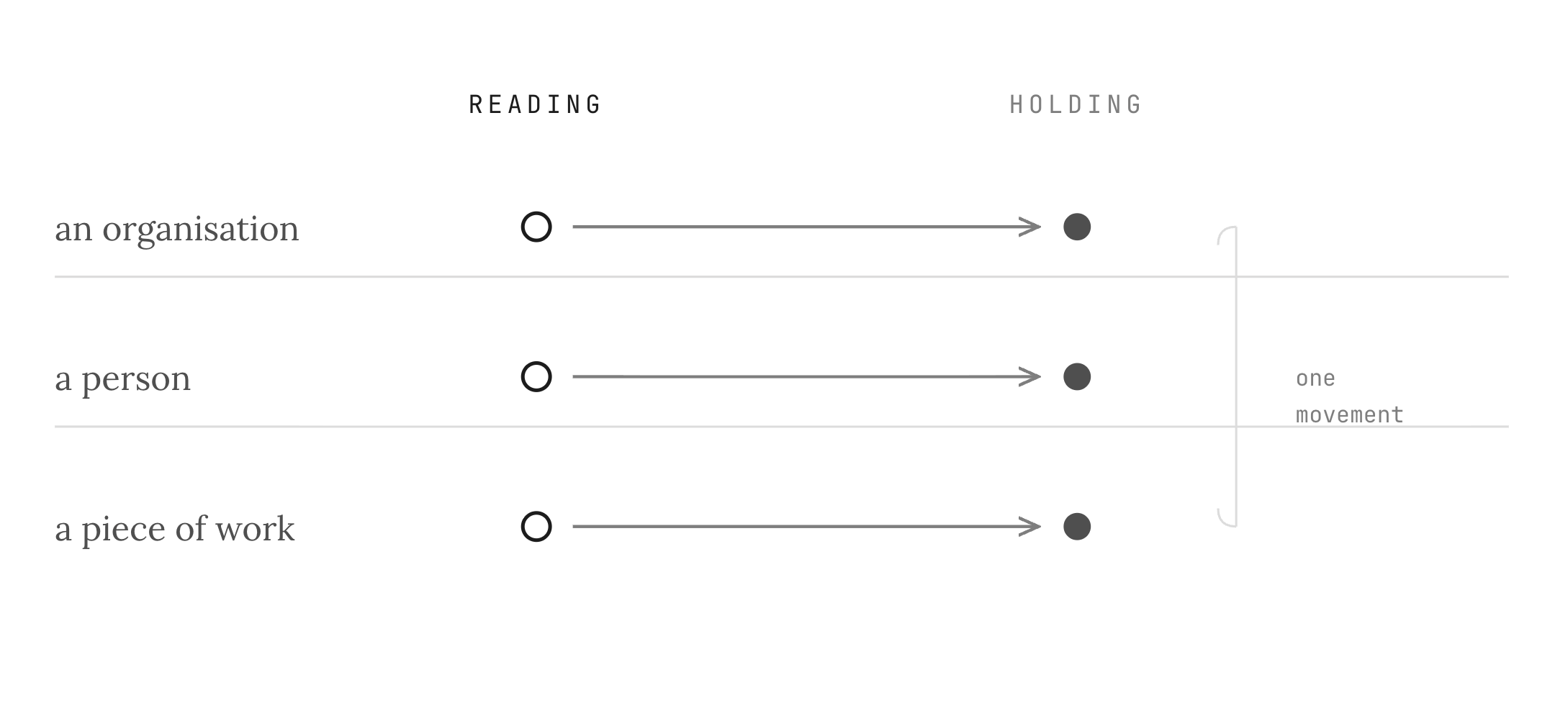
Reading and holding look like two actions. They are two directions of one. The movement beneath them is the not-closing of a form — letting it stand before it is sealed shut. Reading directs that not-closing inward: letting your own perception stand before you reason it away. Holding directs it outward: letting the other person’s perception stand before they — or you — fill it in. The same restraint, in two directions.
What the earlier articles called the brake is the closing inward, onto one’s own perception. Holding is that same not-closing, but directed at the perception of another. That is why it is not doing nothing: it is the withholding of the grasp that presents itself, at the moment it presents itself.
One Movement, Two Tracks
For thirty years my work seemed to consist of two tracks. One was technical and commercial — interim directorships, businesses, projects. The other was human — teaching, guiding, writing. I treated them as two separate things for a long time, and wondered why they refused to congeal into a single career.
They did not congeal because they were not two things. It was the same movement — reading, then holding — directing itself now at an organisation, then at a person. In one instance I read how an organisation actually held together and held that structure until the people within it could see it themselves. In another I read what a person was carrying and held it until they could put it into words themselves. What the movement was directed at differed. The movement itself was always the same.
What the movement was directed at differed. The movement itself was always the same.
What I called two fields was one capacity that would not be divided. That it presented itself as two tracks was not due to its nature but to the world that received it: a world that houses the technical and the human in different buildings, with different words, different invoices. I fitted myself to that division for thirty years. NEXUS is the first place where I no longer do that — where the workshop, the writing, and the two days are not three activities but one movement directing itself at three things.
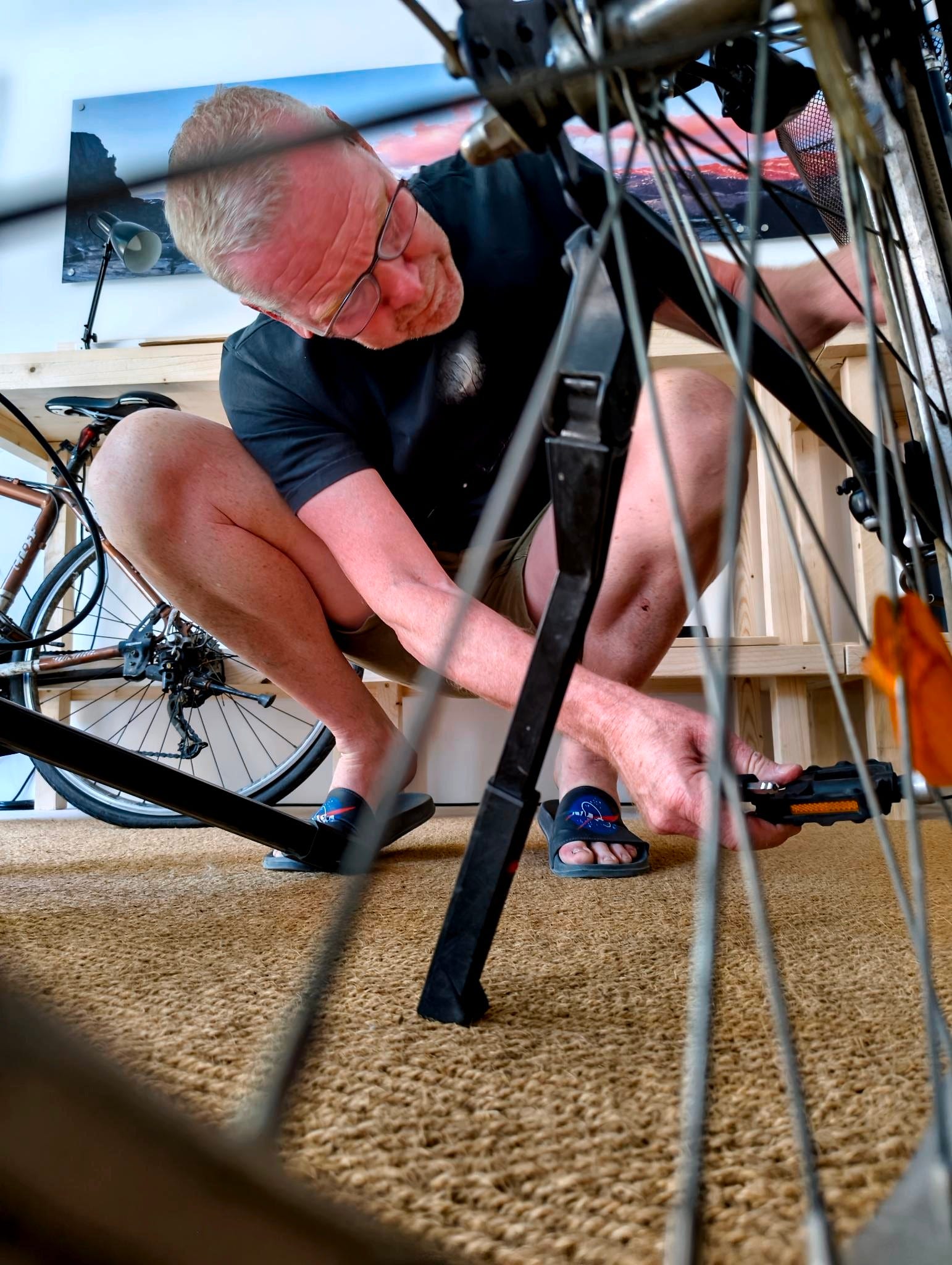
The bicycle I repair and the person I guide are further apart than two professions ought to be. They sit side by side because under my hands it is the same: reading something until I see the structure, and holding it until it works. It was never two things. I just needed two names before I could see the one.
This article is part of a series. Explore the full series here.
Wout and I recorded a conversation on this topic. The conversation is in Dutch.