


Three earlier articles described the form, the person, and the need: an inverted didactic model, the brake as a trained skill, and the reasoned-away need that lies beneath the self-sufficiency. Each time, the focus was on what happens in the half-second. This article shifts the timescale from the moment to the life. The focus is not the single overwrite, but its accumulation across decades — and the price that comes with it. The argument is that much of what is read as character in these people — the withdrawal, the flat distance, the fatigue that belongs to no particular task — is in reality an accrued bill.
I describe why that bill stays invisible (it is paid in installments, each negligible), what it is paid in (self-knowledge, connection, energy), and why it runs highest in those who perceive most acutely. One section is personal. A separate section explains why the price eventually presents itself as character, and thereby appears permanent. The article closes with a bridge to the final one: a bill already paid cannot be reclaimed, but the meter stops where the brake does not need to work — and that is where the next article begins.

Reversal
What Looks Like Nature Is a Price
Three articles described the brake, the person, and the need that lies beneath it. Each time, the half-second stood at the centre: the moment in which a direct perception is overwritten until it is defensible. This article shifts the timescale. It is not the single overwrite that counts here, but its accumulation across an entire life — and what that accumulation costs.
Those who know many such people recognise a recurring image: the withdrawal, the flat distance from others, the restrained pace, and a fatigue that belongs to no particular task. That image is almost always read as character. He is simply a private person. She doesn’t need many people. In the previous article that same formula appeared already, as the sentence by which a learned need is declared to be nature.
What is read as character is often a bill that arrives too late.
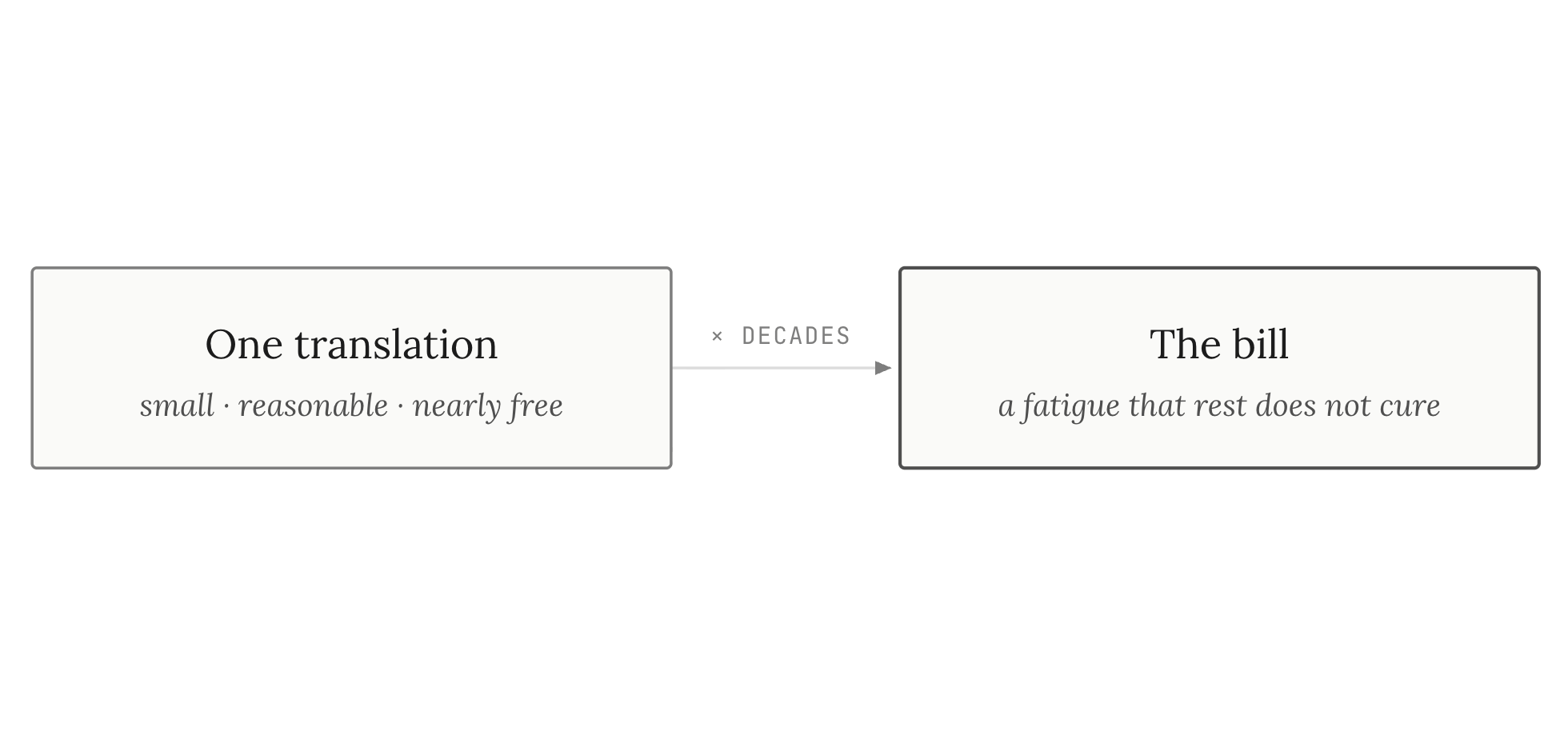
This article departs from that reversal. What looks like nature is, to a large degree, a price: the accumulated consequence of decades of translating. The brake is a skill, and a skill deployed every day for a lifetime drags a bill behind it. Nobody sees that bill, because it was never paid in a single sum.
The Phenomenon
A Bill Without a Receipt
The costs remain invisible because of the way they are incurred. A single translation costs almost nothing. You bring a perception back to its defensible version; that takes half a second, it feels reasonable, often even careful. There is no moment at which you notice you are spending anything. A single entry of a few cents shows up on no statement.
But the movement repeats itself, tens of thousands of times, year after year. What is negligible each time adds up across decades to an amount that no longer is. That is the peculiarity of this price: it does not arise from an event but from a frequency. No disaster can be pointed to, no breaking point — and for that very reason no cause is ever sought. The bill is paid in a currency you do not recognise as money.
The Line Items
What the Price Is Paid In
That currency takes three forms. None of them presents itself as a cost; each has a name that sounds like a virtue.
The first item — self-knowledge
Someone who overwrites their direct perception for years begins to trust it less. The instrument stays sharp, but access to it wears down: you still know something immediately, but you only believe it once you have reasoned your way to it. In time, self-knowledge feels like a suspicion that must first be proven — and the moment when you trusted it without proof can no longer be found.
The second item — connection
Every translation quietly confirms that the other person cannot understand you without one. Decades of that confirmation make closeness an effort that rarely pays off, and the distance that follows — the proverbial back turned to the room — becomes more comfortable than the alternative. Research into social isolation shows that this distance feeds itself and over time even exacts a physical toll12; what began as preference becomes a groove.The third item — energy
Translating runs in the background, even when you do not notice it. Constantly gauging what the other person can handle, adjusting your pace, converting your perception before it is allowed to exist — that is labour. Sociology names the phenomenon directly: the constant adjustment of one’s own expression to fit the surroundings is emotional labour, and it depletes.3 Physiology has its own term for it: the price of sustained adaptation accumulates as a burden that does not lift on its own.4 Labour that never pauses eventually becomes a ground tone you take for yourself.
None of the three items announces itself as a cost. Diminished trust in your own knowledge is called humility; withdrawal is called independence; exhaustion, when it is noticed at all, is called a busy period. Only when added together do they form something that can no longer be reasoned away: a fatigue that no rest cures.
Amplification
Why the Highest Bill Falls to the Sharpest
The price is not equal for everyone. Two things drive it up in the gifted. The first is frequency: the more acutely someone perceives, the more often there is something to translate, and the greater the gap between what they see and what the room can handle. There is simply more overwriting, so the bill accumulates faster.
The second is that intellectual power justifies the expenditure. The stronger someone thinks, the better the story with which they book the costs as a virtue — as thoroughness, as consideration, as composure. The price is therefore not only incurred faster, but paid more willingly and concealed with greater conviction.
Those who see most sharply pay the most and notice it last.
Up Close
A Personal Bill
I can describe this because I paid the bill myself, and did not realise for a long time that I was paying. For years I delivered a fraction of what I was capable of and called it enough — which was also true, for those around me. What I did not see is that the remainder did not stay in reserve, but was spent: not on work, but on the constant reduction of what I perceived to something that was allowed to exist.
The fatigue I know does not belong to any task. Tasks I can manage. It is older than any assignment, and rest does not touch it — it is the fatigue of decades in which almost nothing was allowed to be direct. My circle grew smaller, partly through circumstance, partly because I had quietly stopped expecting the room to follow. I called that independence. It was the bill, arriving late.
Invisibility
Why the Price Presents Itself As Character
The price has, like the brake and the need, a property that makes it invisible from the inside: it is filed under character. The withdrawal is called introversion. The flatness is called level-headedness. The slow pace is called deliberateness. Each a plausible description — and for that very reason, no bill is ever suspected behind them.
Filing it under character does something worse than hiding it: it makes the price permanent. A line item can in principle be stopped; a character trait cannot. Psychoanalysis described how an adapted, outward-facing self can become so convincing that it is mistaken for the actual self.5 Once the fatigue starts to be called “who I am” rather than “what I have paid,” every way out is foreclosed in advance — not because it does not exist, but because it is no longer looked for.
Once the fatigue is called “who I am” rather than “what I have paid,” the way out is closed.
Scope
Beyond Giftedness
Everyone who adapts long enough pays something; the costs of sustained adaptation are a universal human condition.67 What has been described here around giftedness is therefore not a different price, but the same price at a steeper rate: translating more often, being understood less often, and therefore accumulating faster.
Like the previous articles, this one keeps its observations explicitly descriptive rather than diagnostic. It names an accumulation, not a condition, and the fatigue it describes is not a diagnosis but a bill. In a milder form, almost everyone knows the moment when it turns out that something that seemed to run by itself for years was, in the meantime, costing energy that was being tracked nowhere.
Bridge
What Follows From This
A bill already paid cannot be reclaimed. But paying is different from having paid: the price continues for as long as the translating continues. That shifts the question. Not how do I undo the past, but where does the brake not need to work for a moment — because only there does the meter stop.
And that is not a place you make alone. The brake operates everywhere translation is needed, and translation is needed everywhere the other person does not move with you naturally. The only place where the meter falls silent is where no translation is asked for: among equals. What happens there when the brake is idle for the first time — not the price, but what remains when nothing is being deducted anymore — is the subject of the final article.
Four descriptions, one movement. The form, the person, the need, the price. Together they map the brake in full: what it is, for whom it is, why it persists, and what it costs. What is still missing is the only thing that is no longer a description, but an event. The bill makes visible what is at stake. It does not yet say what is gained when it stops.
This article is part of a series. Explore the full series here.
Wout and I recorded a conversation on this topic. The conversation is in Dutch.
Holt-Lunstad, J., Smith, T. B., Baker, M., Harris, T., & Stephenson, D. (2015). Loneliness and social isolation as risk factors for mortality. Perspectives on Psychological Science, 10(2), 227–237. — The measurable toll of prolonged social isolation.
Cacioppo, J. T., & Patrick, W. (2008). Loneliness: Human Nature and the Need for Social Connection. W. W. Norton. — How self-isolation feeds itself and colours the perception of closeness.
Hochschild, A. R. (1983). The Managed Heart: Commercialization of Human Feeling. University of California Press. — Emotional labour: the constant adjustment of one’s own expression, and the exhaustion it brings.
McEwen, B. S. (1998). Stress, adaptation, and disease: Allostatic load and allostatic overload. Annals of the New York Academy of Sciences, 840, 33–44. — The cumulative physiological price of sustained adaptation.
Winnicott, D. W. (1960). Ego distortion in terms of true and false self. In The Maturational Processes and the Facilitating Environment (pp. 140–152). Hogarth Press. — The adapted, false self that is mistaken for the actual self.
See note 4.
See note 3.