


Two prior articles described the form and the person: an inverted didactic model, and the brake — the habit of deeply perceptive people to reason a direct perception shut until it becomes defensible. This article goes one layer deeper, to what lies beneath that brake when it turns toward social life. At the centre is self-sufficiency: the quiet conviction that you do not truly need company, understanding, or closeness. That conviction is usually read as a virtue — autonomy, maturity, not wanting to be a burden. This article argues the opposite. Beneath self-sufficiency lies an ordinary human need, not gone but reasoned away, with precisely the same movement by which the brake overwrites a perception.
I describe what the need is, where self-sufficiency comes from, and why the need grows alongside giftedness rather than shrinking: intellectual power provides ever more convincing grounds for denying it, while the rarity of peers makes it objectively harder to satisfy. A separate section explains why the need presents itself as a virtue and therefore stays invisible. The article closes with the third bridge back to the method: why a need for recognition without translation cannot by definition be satisfied alone, by a speaker, or by a method — but only among peers — and why, for that reason, the group is the instrument.

Inversion
The Virtue That Is Not a Virtue
The previous article showed that the brake conceals itself behind a virtue: someone who reasons their direct perception shut does not experience themselves as overwriting, but as being careful. There is a second virtue, larger and more stubborn than the first, and it concerns not perception but social life. It is self-sufficiency: the conviction that you do not truly need company, understanding, or closeness — that you, with headphones in and your back to the room, function perfectly well alone.
This article begins from the opposite premise. The habit of reasoning away a direct perception — hereafter the brake — is not a fault that was left behind. It is a skill that was built: practised over years, repeatedly rewarded, and refined to considerable precision. To call it a deficit is to confuse an achievement with a symptom. And that confusion is not an innocent terminological error; as the “Invisibility” shows, it is itself part of the reason the brake persists so stubbornly.
Self-sufficiency carries all the hallmarks of a virtue. That is why almost no one sees through it.
This article departs from the opposite assumption. The self-sufficiency of the sharply perceptive adult is not a virtue they acquired, but a need they reasoned away. The movement is the same as the brake’s: there is a direct given — here not a perception but a longing for company that understands — and in the same half-second it is overwritten by its defensible version: I don’t need that. What remains is self-sufficiency; the need itself is already out of the picture. Self-determination theory, incidentally, names belonging and autonomy not as opposites but as two equally fundamental needs.1 Someone who reasons away their need for one under the name of the other makes no virtue visible, but a confusion: beneath the banner of autonomy lies not the absence of a need, but the skill of not feeling it.
The Phenomenon
What Lies Beneath the Virtue
The need is not a general desire for sociability, nor a need for many people. It is specific, and it can be named precisely. It is the need to be seen without having to translate first — to say something, or even nothing, in the presence of someone who follows without explanation. The image that recurs in practice is that of a long car journey: two people, few words, and yet the complete understanding that nothing needs to be added. That — not applause, not affirmation, not company as such — is what is missing.
The overwriting of that need happens in the same moment as the overwriting of a perception. There is a moment when the longing is present: for someone who understands without translation. And almost immediately the second movement arrives — not the question is this allowed to exist?, but the question do I actually need this? — and the answer is built until the longing has been replaced by its contained version: I’m fine, I have my books, my work, my bicycle. The crucial word is again replaced. The need is not postponed and not tested; it is overwritten, and what remains is a life that from the outside looks like contented independence.
Origin
Where Self-Sufficiency Comes From
A child who sees too sharply learns that the direct version of their perception does not land; that was described in the previous article. But in the same process a second lesson is learned, and it cuts deeper. The child who is not understood time and again learns not only to translate — they also learn that the longing to be understood is itself a source of disappointment. The approach costs more than it yields; the room does not move with them. So the child learns, just as adaptively and just as rewarded as when it learned to translate, to no longer feel that longing. Whoever expects nothing is not disappointed.
As with the brake, the dosing eventually turns inward. First you dose what you show others of your needs; eventually you dose what you allow yourself to see of them. Self-sufficiency is the endpoint of that process: a need so consistently suppressed that it is no longer recognised as a need, but as character — I’m just a person who prefers to be alone. That it concerns something learned, under real social pressure and with traceable reward, reveals itself only in the stubbornness with which it is maintained. Cacioppo described how self-isolation sustains itself2: the withdrawal that once protected begins to colour perception, until closeness itself feels like a threat. What began as calm becomes a groove.
First you dose what you show others of your needs. Eventually you dose what you allow yourself to see of them.
Amplification
Why the Need Grows Alongside Giftedness
If self-sufficiency were only a product of disappointment, it would be equally strong in everyone who has often not been understood. But two things amplify it in the gifted person disproportionately, and they work in opposite directions on the need and its denial. The first is rarity. The greater the intellectual power, the smaller the number of people with whom no translation is needed — and therefore, objectively, the greater the distance the need would have to bridge. The need in the gifted is not smaller; it is harder to satisfy, because peers are scarcer.
The second is intellectual power itself, which — just as with the brake — provides the sharpest material for denying the need. The stronger someone thinks, the more compelling the case they can mount against their own longing: that belonging is largely an illusion, that most conversations remain superficial anyway, that dependence is a weakness, that they have moved beyond the need for a group. Each of those lines of reasoning can sound true, and the gifted person formulates them better than anyone. The instrument that could feel the need most keenly also delivers the most convincing grounds for thinking it away.
Rarity makes the need greater; intellectual power makes it easier to deny. It is greatest where it appears smallest.
There is reason to assume that the need in this group is not merely equally large, but larger. Dabrowski described, alongside intellectual overexcitability, an emotional one as well3: a heightened intensity of feeling and attachment. If that is correct, then the longing for genuine connection in the sharply perceptive person is not diminished but intensified — and self-sufficiency is not proof that the need is absent, but the measure of how strongly it had to be held in check.
The Need Itself
Seen Without Having to Translate
It is worth naming the need more precisely, because its shape determines why it is so difficult to satisfy. It is not about belonging in general. The need to belong somewhere is a broad human given4, and in that broad form it can be satisfied by almost anyone. What is missing here is narrower: not company, but recognition without translation. Not being heard, but being understood without the intermediate step that life otherwise always requires.
That distinction explains why the standard solutions don’t work. A network, a club, a coach who affirms — they offer company and acknowledgement, but almost always require the translation that is precisely the problem. The sharply perceptive adult can tell within a single conversation whether the other person moves with them or needs the steps, and in the second case the need is not satisfied but confirmed in its unsatisfiability. Research into the experience of being truly understood points in the same direction5: it is not the amount of contact that determines whether a bond nourishes, but the experience that the other takes you as you take yourself — without you having had to explain yourself first.
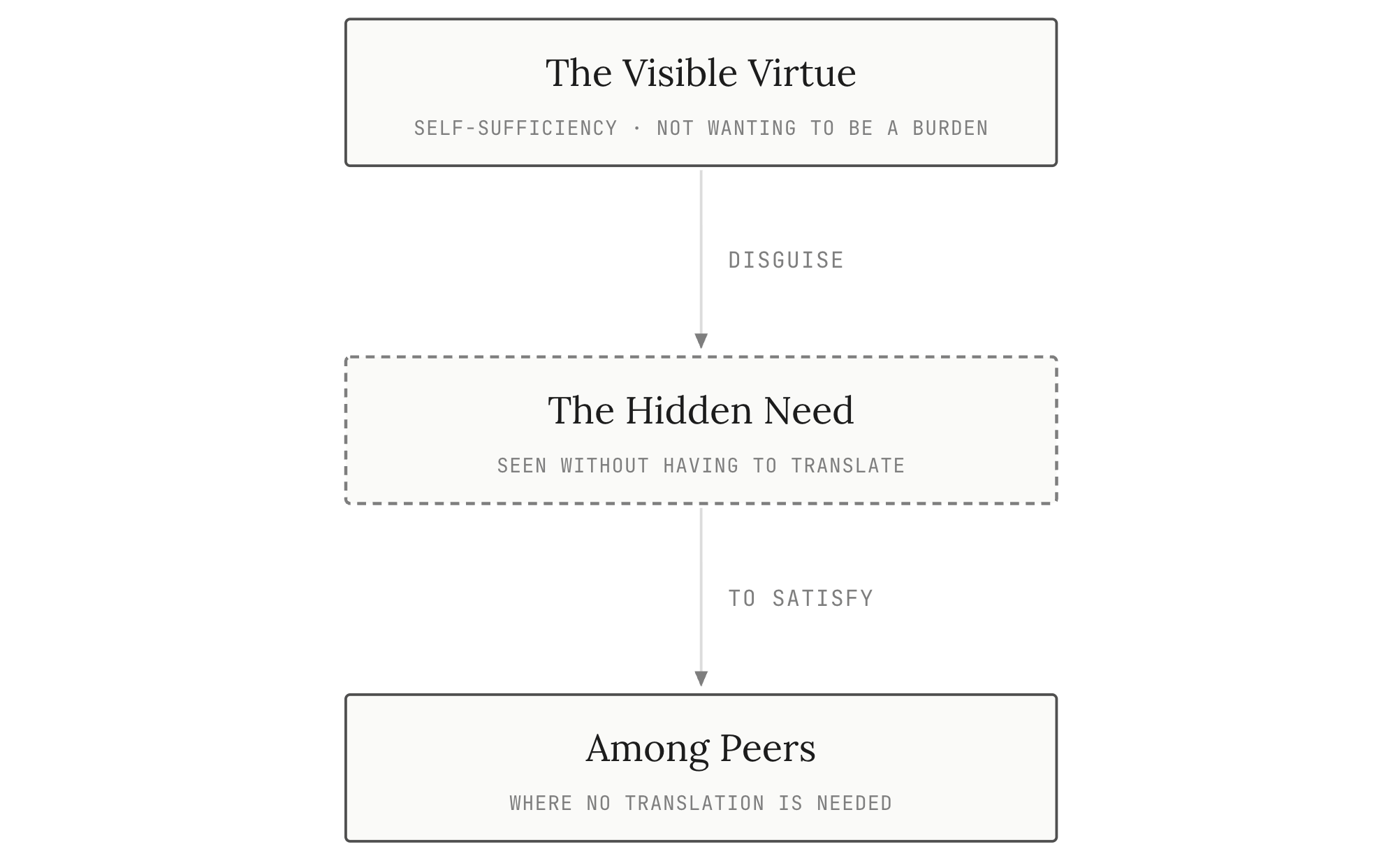
Rogers named as a condition for genuine change that someone experiences themselves as unconditionally understood6 — not judged, not corrected, but taken as they are. For the sharply perceptive adult this is no therapeutic luxury but a rare exception: the condition in which the brake does not need to work, because there is nothing to translate. That is what lies beneath the virtue. Not a lack of independence, but an unsatisfied, precisely formed need for the one situation in which independence is not, for a moment, required.
Invisibility
Why the Need Presents Itself as a Virtue
A need so strongly suppressed should make itself felt. But just like the brake, self-sufficiency has a property that makes it almost invisible from the inside: it wears the mask of a virtue, and the resemblance is genuine. Independence really is a strength. Not wanting to be a burden really is a form of consideration. Being able to bear one’s own company really is an achievement. Self-sufficiency is therefore not merely tolerated but praised — socially, and for those pursuing an inner path of development sometimes spiritually, as a self-containment in the old, positive sense.
And that also explains why encouragements don’t work. “You should get out more” runs up against an attitude that presents itself as maturity, and no one gives up maturity because they’re asked to. Worse still: the encouragement becomes raw material. Someone who hears that they need connection begins to consider whether that is actually true — and that consideration is precisely the movement by which the need is thought away. Every word that names the need invites the reasoning that overwrites it. Self-sufficiency does not need to convince you that you need no one; it is enough that it sets you reasoning.
The need does not need to convince you that you need no one. It is enough that it sets you reasoning.
Scope
Beyond Giftedness
The need for belonging is universal; on that there is little doubt in psychology.78. What has been described here around giftedness is therefore not a separate need but an ordinary need in a sharp form: more strongly suppressed, and harder to satisfy. The mechanism — a genuine need that is reasoned away under the heading of self-sufficiency — occurs in various people who have had to translate for a long time and in doing so have learned to contain their longing for understanding.
This article deliberately keeps that observation descriptive and not diagnostic. It names a movement — the trained overwriting of a social need — and not a label; the question of in whom it takes hold most strongly is different from the question of what it is. Giftedness is here the sharpest case, because both rarity and intellectual power are at their maximum — not the boundary of the phenomenon. In milder form, almost everyone knows the moment when a longing for closeness was briefly clear and then, under their own question “do I actually need that?”, closed again.
Bridge
Why This Requires a Group, Not a Person
If beneath the brake lies a need, and that need takes the form of recognition without translation, then it follows precisely why the method rests on the group and not on a facilitator. Two reasons come together here, and it is important to distinguish them. The first is the epistemic reason the previous article already named: you do not recognise your own overwriting in yourself, but in another person doing it. The second is deeper and concerns not seeing but satisfying: a need for recognition without translation cannot by its nature be met by one person in a role.
A facilitator who understands does so from a role, and a role requires — however subtly — the translation that must now fall away. A method that addresses the need makes it an object, and a need that is made into an object is reasoned away again. And alone simply does not work by definition, because it is a need for another. What remains is the group: not as a didactic tool, but as the only place where the need can be answered, because recognition there is not granted but happens — between people who owe each other no explanation.
The group is not a tool of the method. It is the only place where the need can be answered.
Three articles, one whole. The first described the form; the second the person for whom the form was made; this one described the need that lies beneath that person and gives the form its place. Understanding is not learned — it comes naturally to those who have the intellectual power. What does not come naturally is the one situation in which it is not required: in which being seen is not an achievement and the brake is briefly idle. The NEXUS Werktage is the attempt to create that situation. Beneath self-sufficiency lay never a lack of independence — only a lack of peers.
This article is part of a series. Explore the full series here.
Wout and I recorded a conversation on this topic. The conversation is in Dutch.
Ryan, R. M., & Deci, E. L. (2000). Self-determination theory and the facilitation of intrinsic motivation, social development, and well-being. American Psychologist, 55(1), 68–78. — Autonomy and belonging as two equally fundamental, non-opposing basic needs.
Cacioppo, J. T., & Patrick, W. (2008). Loneliness: Human Nature and the Need for Social Connection. W. W. Norton. — How self-isolation sustains itself and colours the perception of closeness.
Dabrowski, K. (1964). Positive Disintegration. Little, Brown. — Theory of positive disintegration and the overexcitabilities, including the emotional.
Baumeister, R. F., & Leary, M. R. (1995). The need to belong: Desire for interpersonal attachments as a fundamental human motivation. Psychological Bulletin, 117(3), 497–529. — The need to belong as a fundamental human drive.
Reis, H. T., & Shaver, P. (1988). Intimacy as an interpersonal process. In S. W. Duck (Ed.), Handbook of Personal Relationships (pp. 367–389). Wiley. — Being understood, not the amount of contact, as the core of a nourishing bond.
Rogers, C. R. (1957). The necessary and sufficient conditions of therapeutic personality change. Journal of Consulting Psychology, 21(2), 95–103. — Experiencing oneself as unconditionally understood as a condition for change.
See note 4.
See note 1.