


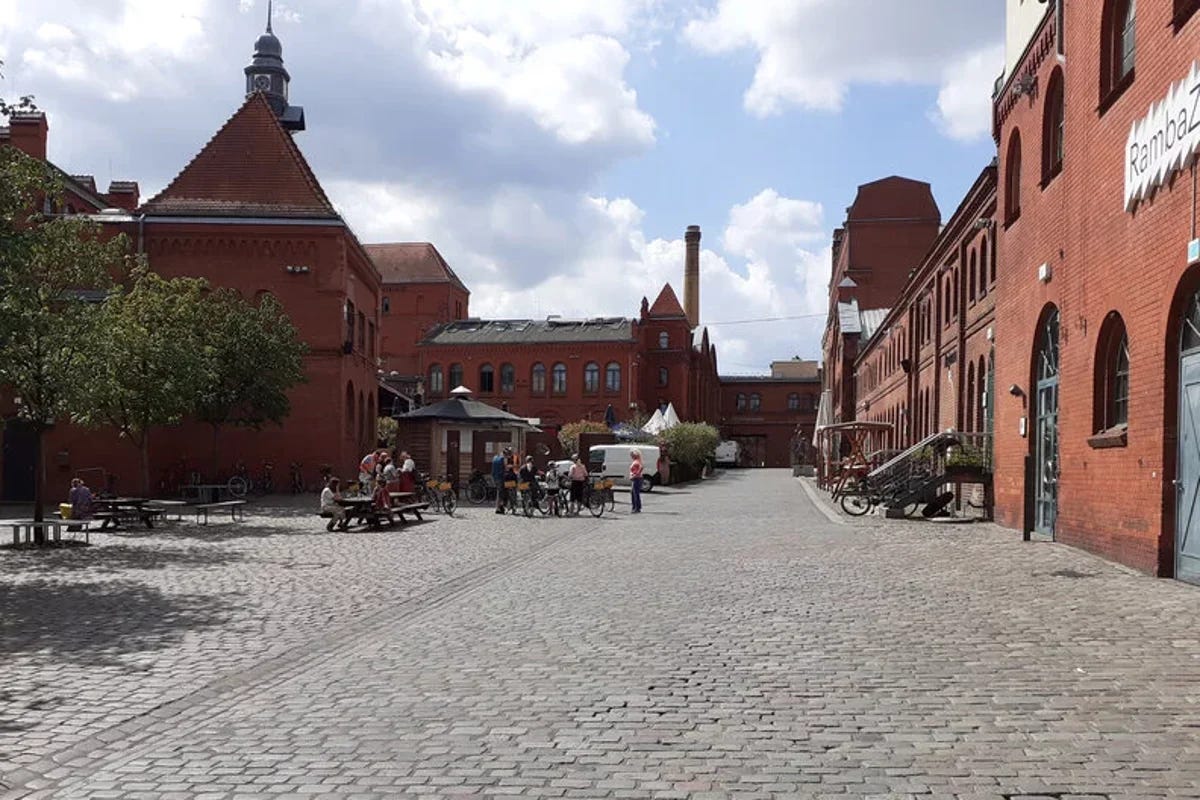
There are moments when everything you’ve been moving through for years starts to take shape. Last week in Berlin was one of those moments.
Not because things suddenly became easy — but because, for the first time in a long time, there was alignment between what I see and what I encounter.
This essay is written from that point.
Introduction – The Problem
The experience of feeling “lost” is often interpreted as a lack of direction, clarity, or fit within existing structures. However, for a specific group of individuals, this interpretation is misleading.
What appears as disorientation may instead reflect a mismatch between the way reality is perceived and the frameworks available to navigate it.
Most social and institutional systems are built on linear progression. They assume that understanding develops step by step, that meaning is constructed sequentially, and that coherence emerges over time. These assumptions are embedded in education, organizational structures, and decision-making processes.
For individuals with a more simultaneous mode of perception, this structure does not align with lived experience. Rather than constructing understanding incrementally, they tend to recognize patterns, inconsistencies, and underlying structures in an immediate and integrated manner. Coherence is not the outcome of a process; it is perceived at once.
This difference is not merely cognitive, but structural. It creates friction within systems that rely on sequential explanation and standardized validation. Insights that are internally coherent may be difficult to translate into stepwise reasoning. What is immediately clear to the individual may be perceived by others as premature, insufficiently substantiated, or disruptive.
Over time, this leads to a recurring tension between internal clarity and external recognition. This tension is frequently interpreted at the individual level—as a lack of fit, direction, or capability. However, such interpretations overlook the systemic dimension of the issue.
The underlying problem is not that the individual is unable to navigate the system. The problem is that the system is not designed to accommodate this mode of perception.
In that sense, the experience of being “lost” does not indicate an absence of orientation. It indicates that the available map does not correspond to the terrain being perceived.
I want to thank everyone I met during my time in Berlin.
The conversations were open, direct, and without unnecessary layers. That matters more than it seems.
You don’t often meet people where there is no need to translate what you see.
Those moments made a difference.
Bis bald,
Ron van Helvoirt
Abstract
This essay reconceptualizes giftedness not as a quantitative measure of intelligence, but as a distinct perceptual structure that interacts problematically with standardized social and institutional environments. Drawing on reflective practice and lived experience, it outlines a developmental trajectory characterized by friction, detachment, restructuring, and eventual materialization in the form of NEXUS Werkstatt GmbH.
A central claim is that certain forms of transformation cannot be externally taught or accelerated, but must emerge through direct experience.
The analysis addresses key paradoxes, including resonance and isolation, meaning and meaninglessness, and autonomy within conditions of dependency. It further explores the challenge of developing adequate language to describe non-normative perception. The essay argues for a shift from conformity to socially constructed frameworks toward a mode of living grounded in directly perceived reality.
NEXUS Werkstatt GmbH is presented as a practical instantiation of this shift—not as a solution, but as an enabling environment in which individuals with similar perceptual structures can operate without reduction.
Beyond Intelligence: Rethinking Giftedness
Giftedness is commonly conceptualized as elevated cognitive ability, often operationalized through standardized testing. Such approaches reduce the phenomenon to a measurable deviation within a normative framework and thereby obscure its qualitative dimension.
From the perspective developed in this essay, giftedness is not simply an increase in cognitive capacity, but a difference in perceptual organization.
Perception is understood here as a form of simultaneous processing in which coherence is recognized directly, rather than constructed step by step. Meaning emerges as an integrated gestalt, rather than as the outcome of sequential reasoning. This perceptual structure frequently conflicts with institutional environments that rely on linearity, standardization, and procedural governance.
The resulting tension extends beyond the experience of being “different.” It reflects a persistent misalignment between internal coherence and external validation, often culminating in a developmental rupture.
Systemic Friction: When Perception Exceeds the System
Social systems are designed to optimize continuity, predictability, and control. They reduce complexity to manageable components and tend to interpret deviation as risk rather than as a potential source of insight. Within their own parameters, such systems function effectively, but not necessarily in alignment with lived reality.
For individuals who perceive systemic inconsistencies immediately and holistically, this creates sustained cognitive and existential tension. The issue is not an inability to adapt, but the difficulty—or refusal—to reduce one’s perception to fit institutional constraints without compromising internal coherence.
This tension is frequently misinterpreted as an individual deficit, while in fact it reflects a structural mismatch.
The In-Between Space: Restructuring Without a Map
When systemic structures no longer provide a valid reference frame, individuals often enter a transitional phase—a liminal zone in which old frameworks have dissolved while new ones remain unformed.
This period is characterized not by confusion, but by the absence of external validation. Internally, a process of reconfiguration takes place, involving observation, integration, hypothesis testing, and the search for language capable of articulating non-normative experience.
Socially, this phase may appear as stagnation or uncertainty. Phenomenologically, it functions as a necessary precursor to coherence.
The Paradox of Dependency and Autonomy
During this restructuring, the individual remains embedded in economic, social, and institutional systems that they simultaneously question. This dual position—inside and outside at once—produces a form of lived paradox.
Autonomy in this context should not be understood as the absence of dependency. Rather, it refers to the capacity to engage with systems consciously, without internalizing their limitations.
Rare Resonance: Encounters Without Translation
Amid this process, moments of resonance with others who share a similar perceptual structure are rare but significant. These encounters require no translation—perception aligns immediately.
They do not provide direction or instruction, but validate through shared recognition. They demonstrate that the developmental path, while individual, is not necessarily solitary.
The Limits of Guidance: Experience as the Only Transferable Medium
Conventional forms of support—coaching, therapy, guidance—assume that development can be accelerated through intervention. For certain forms of transformation, this assumption does not hold.
There are processes that cannot be taught, and shortcuts that cannot be taken. Some forms of integration arise only through direct engagement with friction, uncertainty, and tension. Attempts to bypass or soften these conditions often interrupt precisely the transformation they aim to facilitate.
Resonance can accompany the process. It cannot replace it.
Loneliness: Productive Isolation and Latent Danger
The scarcity of resonance produces a form of existential loneliness. This loneliness is not primarily social; it stems from inhabiting a perceptual reality that others do not share.
This state offers clarity by minimizing noise, yet it also carries risk. Solitude can become a refuge so stable that re-engagement with the world begins to feel threatening. What initially supports development may, over time, begin to constrain it.
The central challenge lies in maintaining perceptual clarity while re-engaging with broader social contexts.
The Need for New Language
Existing language frameworks are grounded in linear and measurable assumptions. As such, they are insufficient to articulate experiences arising from simultaneous or gestalt-based perception.
This linguistic gap leads to misinterpretation and reduction. Developing new language is therefore not a matter of stylistic preference, but a requirement for epistemic precision. Language does not merely describe experience; it structures and enables its transmission.
Meaning and Meaninglessness: Holding Both Without Resolution
In the developmental process described here, meaning and meaninglessness coexist. Social systems often reveal themselves as contingent constructions, which can evoke a sense of arbitrariness or emptiness.
At the same time, meaning emerges directly through coherence, presence, and resonance—independent of institutional validation.
The challenge is not to resolve this tension, but to sustain it and act from within it.
NEXUS Werkstatt GmbH: A Field Becomes Material
NEXUS Werkstatt GmbH did not originate as a predefined plan, but as the material consequence of the developmental trajectory outlined above. It is less an organization than a field—a convergence of practical work, economic interaction, intellectual inquiry, and lived experience.
It functions as an interface between abstract insight and practical reality, anchoring perception in action and preventing conceptual drift.
NEXUS does not aim to solve a problem. It creates conditions in which reduction is no longer required and clarity is not penalized.
It is a beginning, not a conclusion.
Conclusion: Living in Reality
The central question of this essay has been how a gifted perceptual structure can develop outside the logic of conventional systems.
The answer does not lie in optimization, adaptation, or accelerated intervention. It lies in direct experience, in friction, and in the capacity to create new structures grounded in lived reality.
What is commonly referred to as “reality” is, to a significant extent, socially constructed. These constructions are functional, but not absolute. Living in reality therefore entails recognizing their contingent nature and consciously determining one’s relationship to them.
Not as a passive participant, but as an active agent in their design and navigation.
NEXUS Werkstatt GmbH represents one such design—a place where clarity is not treated as a liability, and tension is not pathologized but utilized. Development here occurs not despite difficulty, but through it.
The path remains uneven, but it becomes traversable—not by smoothing it, but by walking it fully.
Good analysis Ron!