


Throughout this piece, I use the term “high-bandwidth Mavericks” and similar. If you’re more familiar with the language of giftedness or gifted individuals, you can mentally substitute that framing here. I don’t find the label myself accurate, but the underlying experience overlaps more than the terminology suggests.
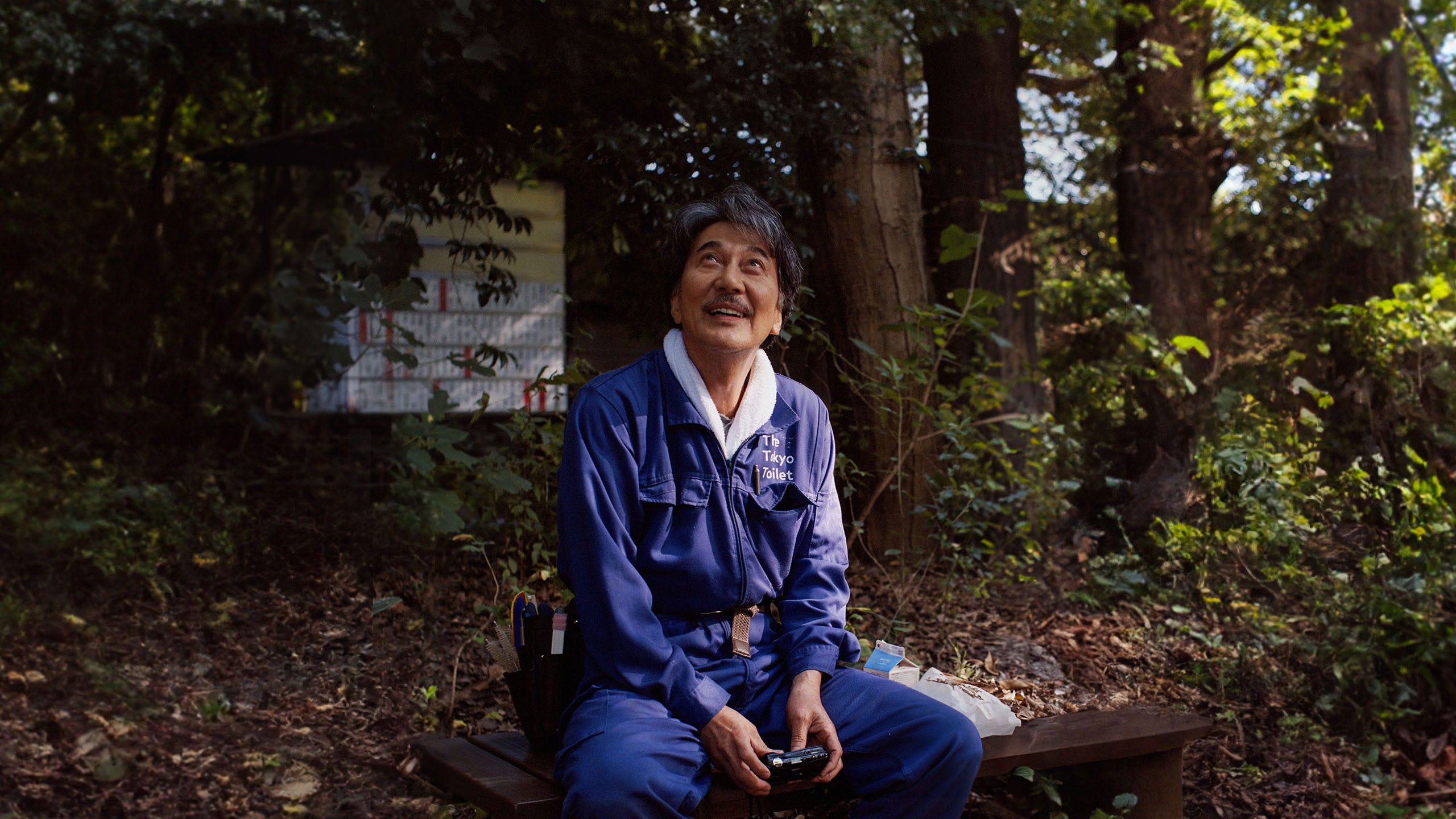
There is a scene in Perfect Days where the main character, Hirayama, lies under a tree during his lunch break and looks up. He is a toilet cleaner in Tokyo. He has cassette tapes, a handful of books, some small plants he waters every morning, and a camera he uses to photograph light falling through leaves. That is more or less his life. And for the duration of the film, he is more present than almost anyone you will ever meet in real life.
I have been thinking about why that image stays with you. Not because he owns little, not because he has opted out of something, but rather because of what he has opted into instead. You see, there is a Japanese word for what he keeps photographing: komorebi (木漏れ日). Sunlight filtering through trees. The way light patches itself across your face when you are sitting under a tree and the branches are gently swaying in the wind. It is not a remarkable thing. It happens every day, and everywhere. Yet, most people never notice it because they are not sitting still long enough, or they are looking at something else.
But here is the thing about komorebi that I keep coming back to. You only get it because the tree is in the way. The tree blocks the light first, and then breaks it into flickers. That interruption is what catches you. Without the tree, the sun is just the sun, too constant and too bright to consciously register. It is the obstruction, the breaking of the usual pattern, that creates the moment of noticing. And I think that is the whole thing, right there.
That, I think, is the actual subject of the film. Not minimalism as a lifestyle choice, not some romanticised vision of poverty or simplicity, but the specific kind of attention that becomes possible only when you stop chasing the next thing. Yes, Hirayama owns a car. He has music he loves. He has rituals and routines that are genuinely his. So, the point is not that he has almost nothing. The point is that he stopped adding to the pile the moment he had collected the fundamental things that he needed, and that decision gave him back every minute of his life.
There is an inscription carved into a stone basin at Ryōan-ji Temple in Kyoto, dating back to around the 1600s: Ware, tada taru wo shiru (吾唯足知). I know what “just enough” is. The problem, as the philosophy goes, is not that we do not have enough. The problem is that we have lost the ability to recognise when we do.
NEXUS is for people who already know, somewhere, that something is off. High-bandwidth Mavericks, I call them. People who process the world faster and more conceptually than the environments around them were designed to handle. People who, in the wrong setting, get told they are the problem. Labelled, medicated, managed. Told to slow down or fit in or be realistic. And the more of these people who find each other and start naming what they are experiencing accurately, the less any of us have to keep pretending the problem is us.
What I have noticed is that the high-bandwidth Maverick often burns out not because they lack capacity, but because they spend so much energy operating inside systems that were never built for the way they move. And one of the quieter casualties of that is presence. You become so used to running on autopilot inside structures that do not fit you, that you forget what it feels like to actually be somewhere. To notice the light.
I have been thinking about this in a much smaller and more personal way lately. I have been trying to write by hand more. Not because writing by hand is inherently better, not because I think pen and paper is some superior technology, but because I noticed something about how I was using my laptop. I would open it to write, and ten minutes later I would be watching something. The device had become a source of input rather than a place I gave input to. That shift, from producing to consuming, is subtle and it happens almost without you noticing. So I have been trying to keep the things I own more separated in what they actually do. The laptop is for work, for output. A notebook is for thinking. A record or a CD is for listening to something fully, from beginning to end, in a room, without also doing four other things.
This is most likely part of why physical formats are having a quiet comeback, and I do not think it is purely nostalgia or some collector/ownership instinct. There is something about the object itself that creates a different relationship to the thing it contains. A record you have to get up and flip over. A cassette you cannot skip. A book you hold in your hands. The medium shapes how you receive it, and some media ask more of you in a way that ends up giving more back.
Hirayama has a line in the film that his niece triggers when she asks when she will see him again. He says, gently, “Next time is next time. Now is now.” It is such a simple thing to say and such a difficult thing to actually believe. Most of us spend our dinner thinking about tomorrow. Most of us finish a song through our phones thinking about the next one to play. The attention goes everywhere except where the body currently is at.
So here is the practical question, because I think it matters: how do you pull yourself out of autopilot if you are never present enough to notice you are on it? You cannot decide to be present from inside an unconscious state. Something external has to flicker first. The tree has to break the light.
Which means the actual practice is not about achieving some permanent state of awareness. It is about deliberately putting more trees in your path. Structuring your day so that life, the universe, gets more chances to snap you back. A walk without headphones. A notebook instead of a notes app on your phone. A ritual that requires your hands and your attention and nothing else. Not because these things are virtuous, but because they create the conditions for the flicker. And every time the flicker happens and you notice it, you become slightly more capable of noticing the next one without needing as much of a jolt.
For the high-bandwidth Maverick, this should not sound abstract. You already feel the world more acutely than most. The problem is usually not that you cannot be present. It is that the environments you have been placed in have trained you to suppress that sensitivity rather than work with it. And so, what feels like distraction or restlessness, or not fitting in, is often just your nervous system looking for something real to land on.
The komorebi is still there every day, falling through whatever trees are nearby, landing on whoever happens to be sitting still enough to notice it. To notice it is to break the spell. You do not need to overhaul your life. You just need to find the trees, put them in your path, and let them do what they are designed to do. (and smile)
For more information on NEXUS, the NEXUS Werkstatt in Berlin, our 1:1 sessions, transmissions, books and other items, please visit our website nexuswerkstatt.com, or reach out directly.
Yes, the movie "Perfect Days" is for me also very good, you can't forget it. I didn't remember much speaking but beautiful simple scenes. You can find an answer on the question: what means living?
No ego but doing the best you can and be interested in. A routine but being a conscious human. Also be friendly to others and help them to become also close to themselves. It's about the simple things in live and enjoy them in your heart.
But...many find this movie to slow, they are used to the system. When the daughter comes visiting, the mother looks with pity to her ex husband. But the girl is interested and she became proud of her father and learned much. So it has to be, also in our world: making real connection even if people are different from each other. Not only for people who are wired different but everybody! And instead of walking with your phone in your hand(isolated), look around and say goodbye or make a talk. I can tell, you wil leave with a smile on your face and energie in your soul. This you can't buy, it's for free, enjoy your day.